For the research topic of our studio: The dynamic self-organizing principles of the emerging post-Fordist network society – variation, flexible specialization, and networking – make modernist urbanism and modernist architecture no longer conducive to stimulating the creative energy and productivity of multiple collaborations.
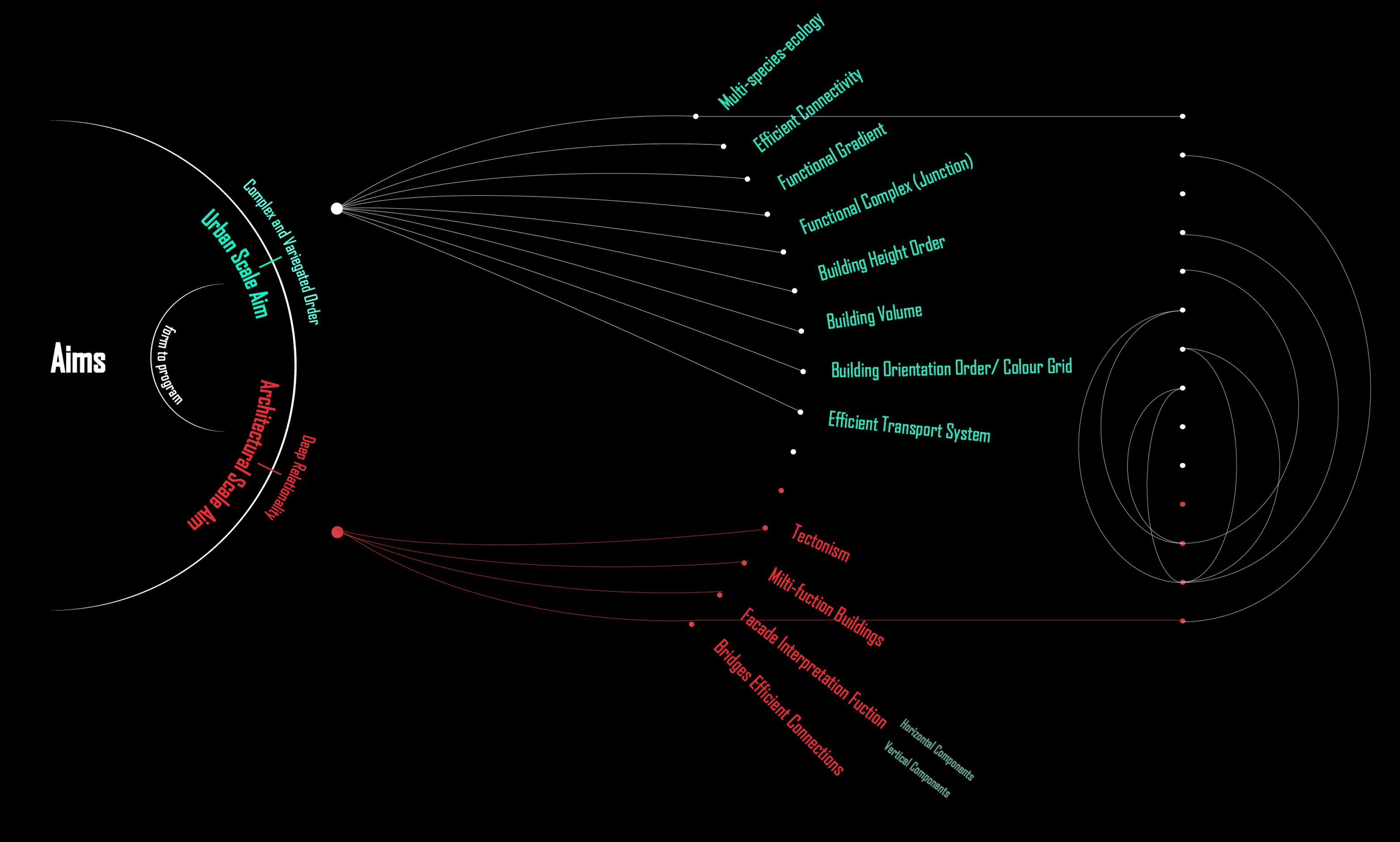
We need a complex, legible urban design strategy beyond collage city, that adapts to the multi-species-ecology, with a certain global order.
This is a studio foregrounding form-making and composition, in the service of achieving social-functional values like urban legibility and identity, to facilitate orientation and navigation, so that a rich diversity of urban offerings can be effectively delivered to end-users. The key urban design task addressed in this studio is thus to maintain legibility in the face of complexity.
From urban scale to architectural scale, this deep relationality intensive coherent the global order we created from every scale.
In our previous work, we conducted research on various generative algorithms such as the wool thread algorithm, swarm behaviour, and slime mold algorithm. We attempted to use these algorithms to create patterns for different urban systems. After obtaining some simulation results, we applied them to different branches of a linear city prototype. Each branch employed a different algorithmic generation logic, gradually combining them to observe the diverse urban spaces formed through their overlay.
Based on the above algorithm research, we found that the orders formed by these algorithms are relatively singular and sometimes unable to adapt to complex sites. Moreover, when overlaid, they fail to create a clear and strong global order, lacking the complex differentiation and relationality required for a city.
Therefore, we continued our search for something new that could achieve these goals, and we found these elements in the simulations of twirl.
The image of a twirl fabric gently introduces peripheral networks and fabrics into our site and creates its own order within. The form, with its twin qualities of convergence and dispersion of multiple trends, is well suited to our vision of a reorganisation of the collage city into an urban design suited to post-Fordism’s networking and collaborative working qualities. It can guide multiple flows of people converging to a common, unique hotspot while different twirls also interfere with and influence each other, corresponding to the modern productive lifestyle of interpenetration between different groups of people (work types).