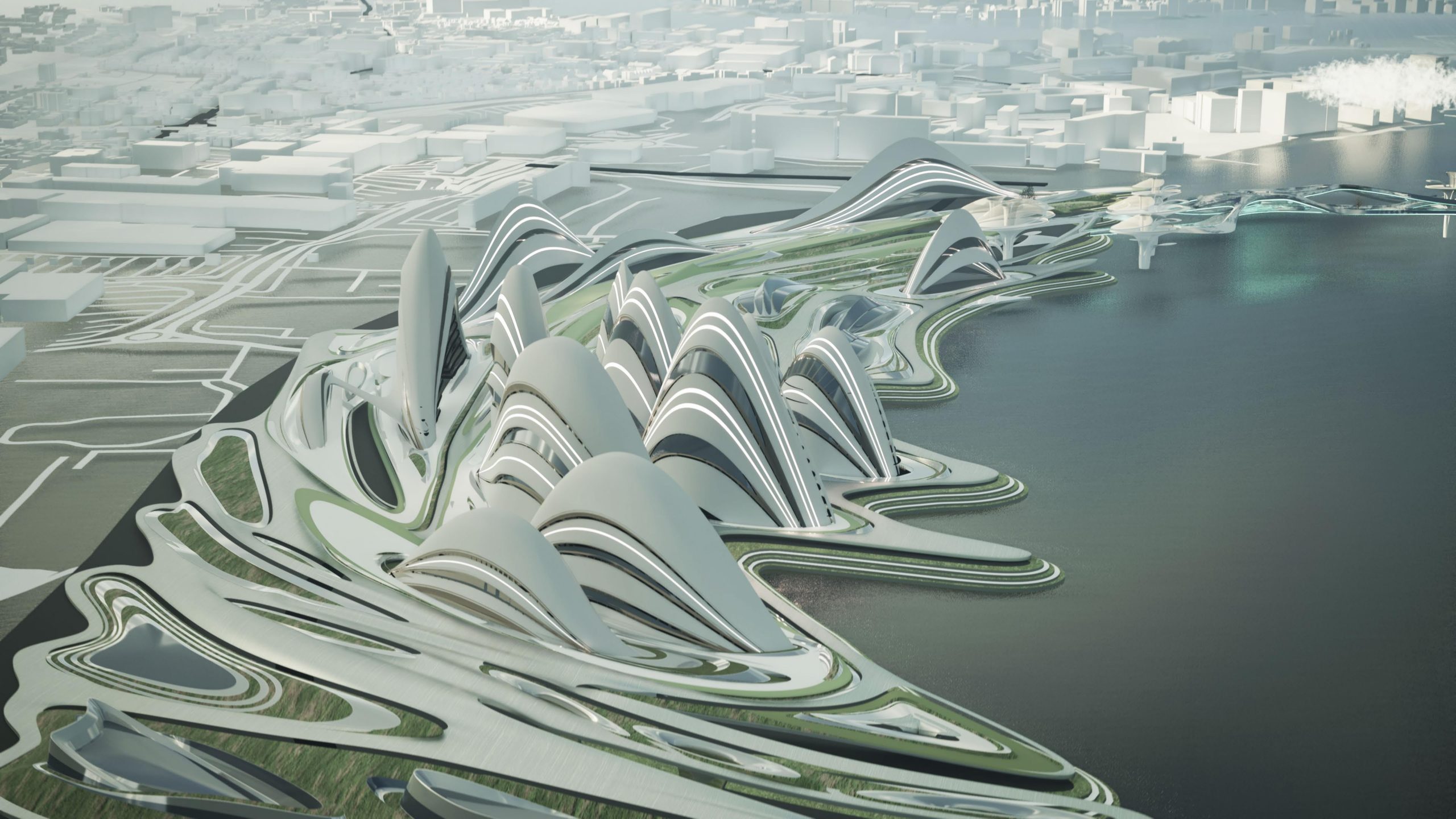
One important aspect of this project is that architectural design, both in terms of building morphology, and importantly, also in terms of detailed façade articulations, is tasked with performing urban scale articulation work. The façade designs are systematically varied across the site, with an emphasis on depth, so that the appearance of the urban formations become sensitive to both sun-light conditions (light and shadow) and to observer perspectives (tangential views versus perpendicular views). This also implies that the facades operate visually across large urban distances.
The building shape and façade articulation should also operate in the semiological dimension: relative spatial position, programmatic differentiation, and conditions of programme mixity must be able to be read off from the architectural articulation. The differential depths of the facades also relate to the sun-directions. This too gives global orientation, across otherwise very different articulations. The overall character of the district design should be unprecedented by achieving visual unity and order while simultaneously displaying a rich variety of identifiable offerings.
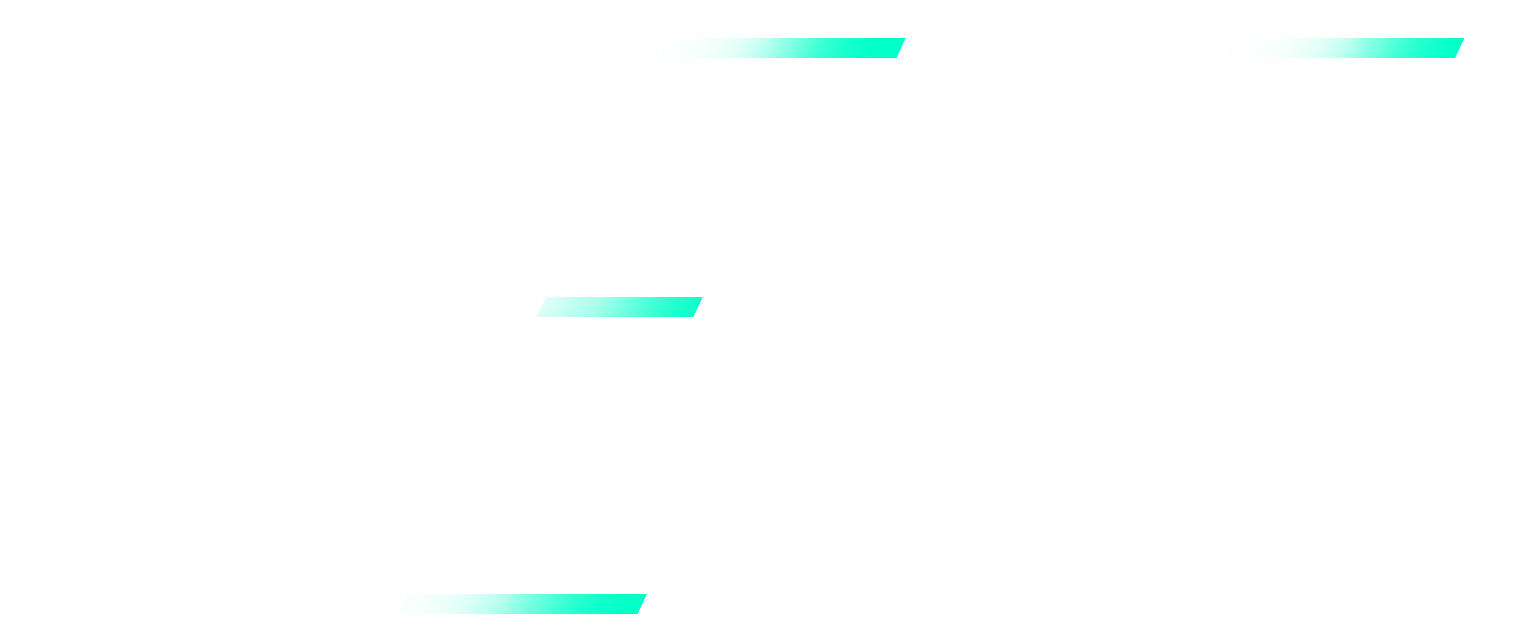
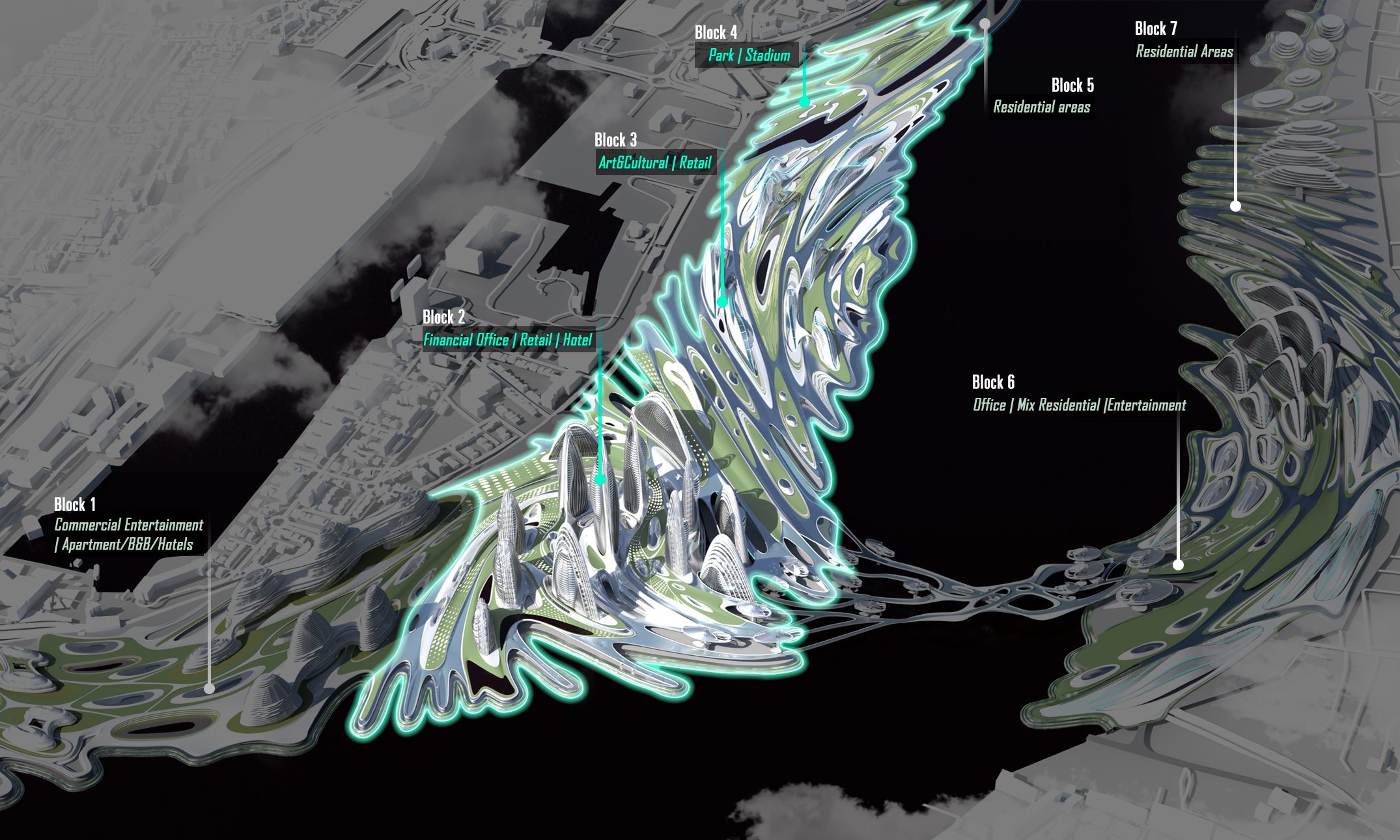
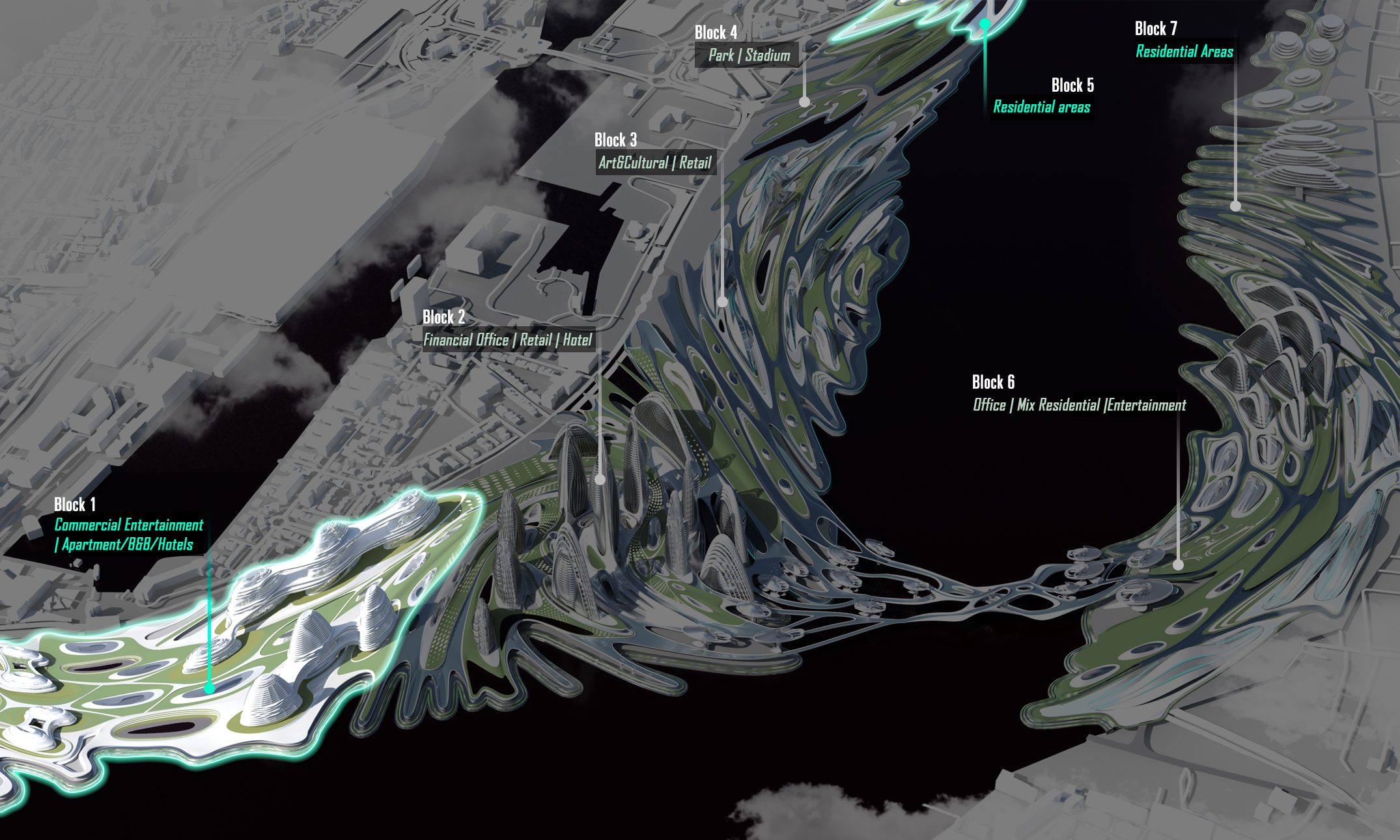
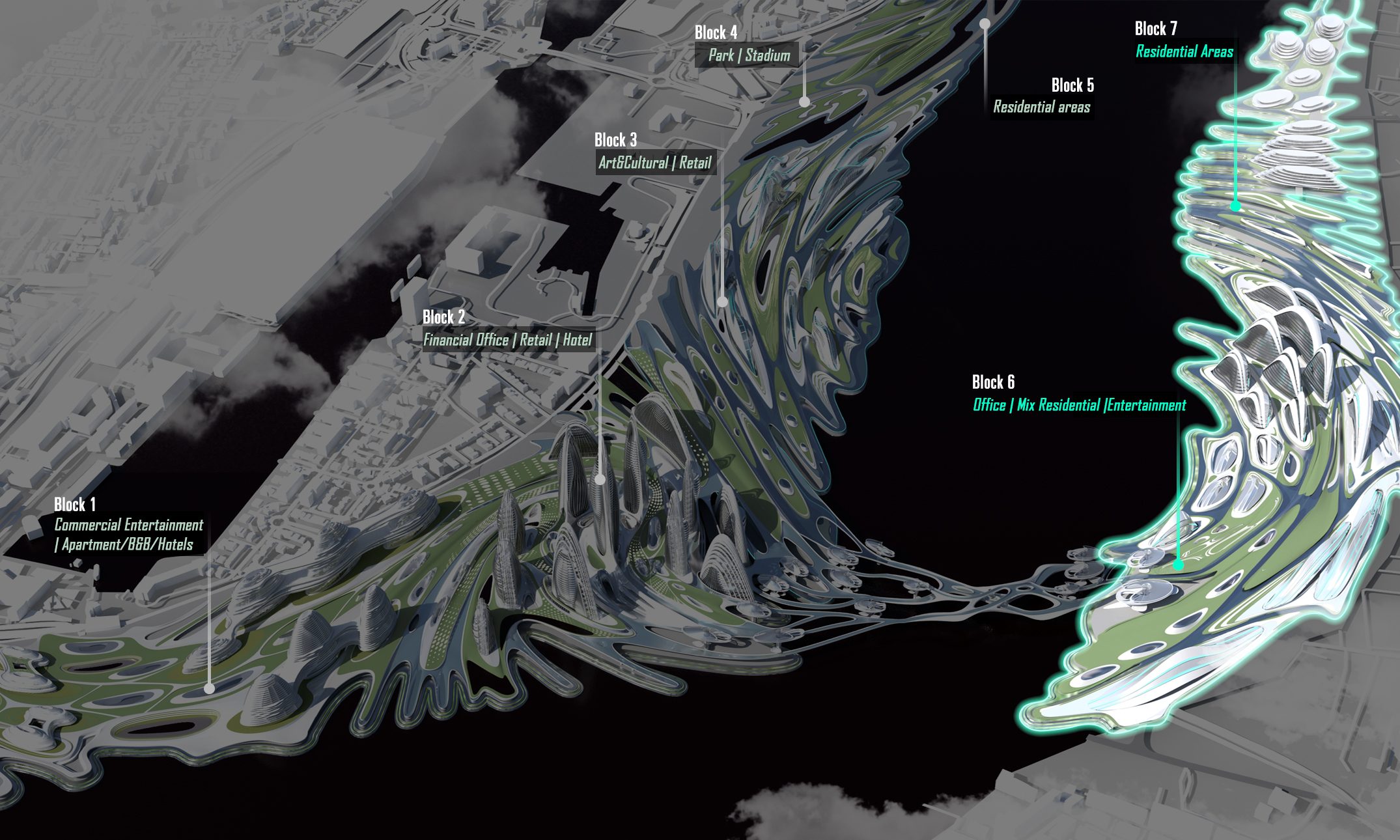
Firstly, We split the master plan based on its morphological feature and assigned them different mix functions with a dominating usage. We will introduce them in three chuncks based on the hierachy to the central junctional area.
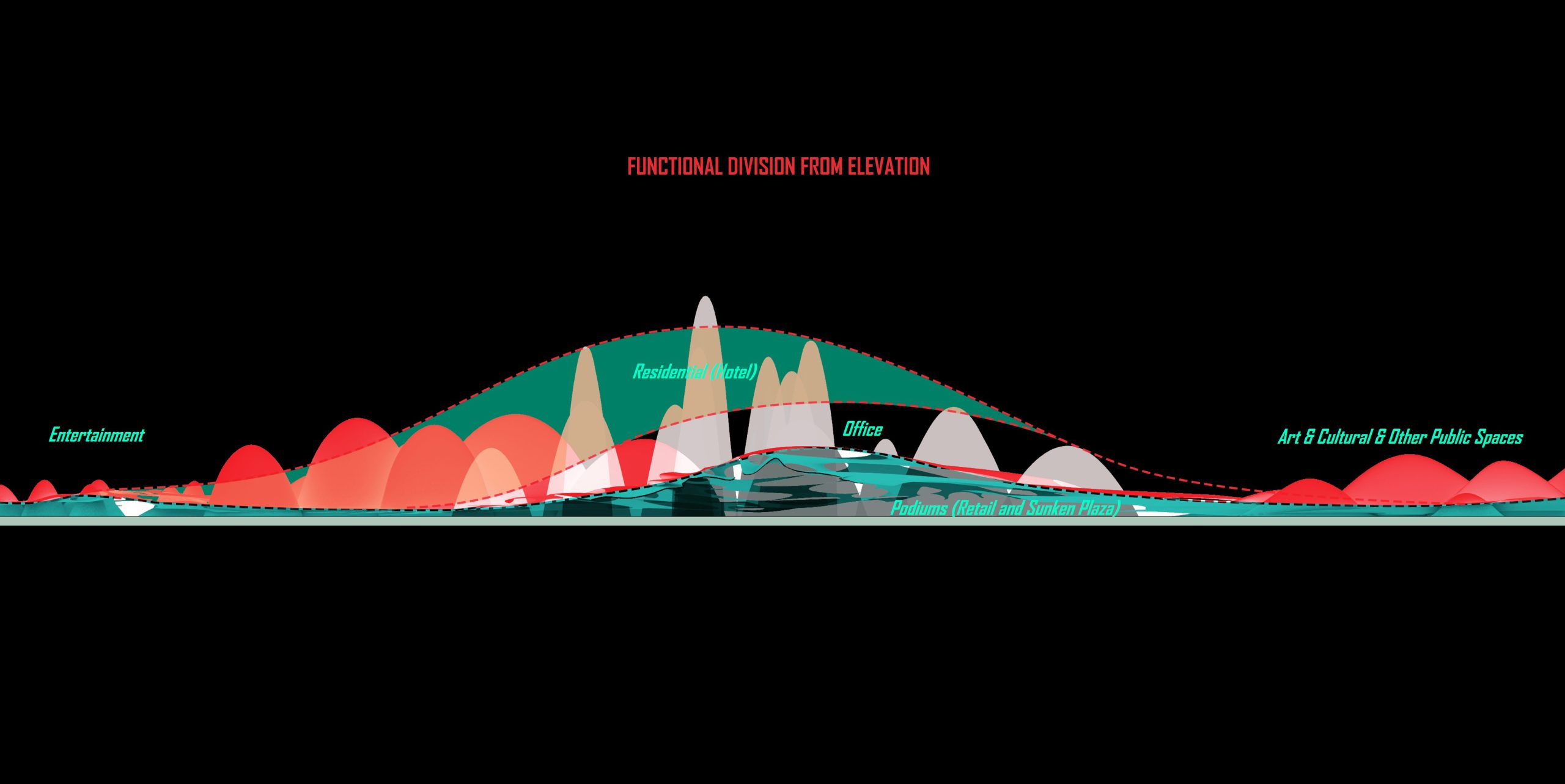
According to the requirement of the scheme that the façade form indicates the function, we simplify the function into four categories, namely residential, office, retail and art and culture, and divide the zones vertically as a whole. Our aim is for single buildings to form a mix of uses, while at the same time, there is an overall trend of vertical zoning for functions on clusters of buildings. As we mentioned in the twirl skin study, most of our retail functions will be located on the podium underneath the skin.
To imply functions by its appearance, we distinguish façade language for office, residential, art and cultural, as well as retail.
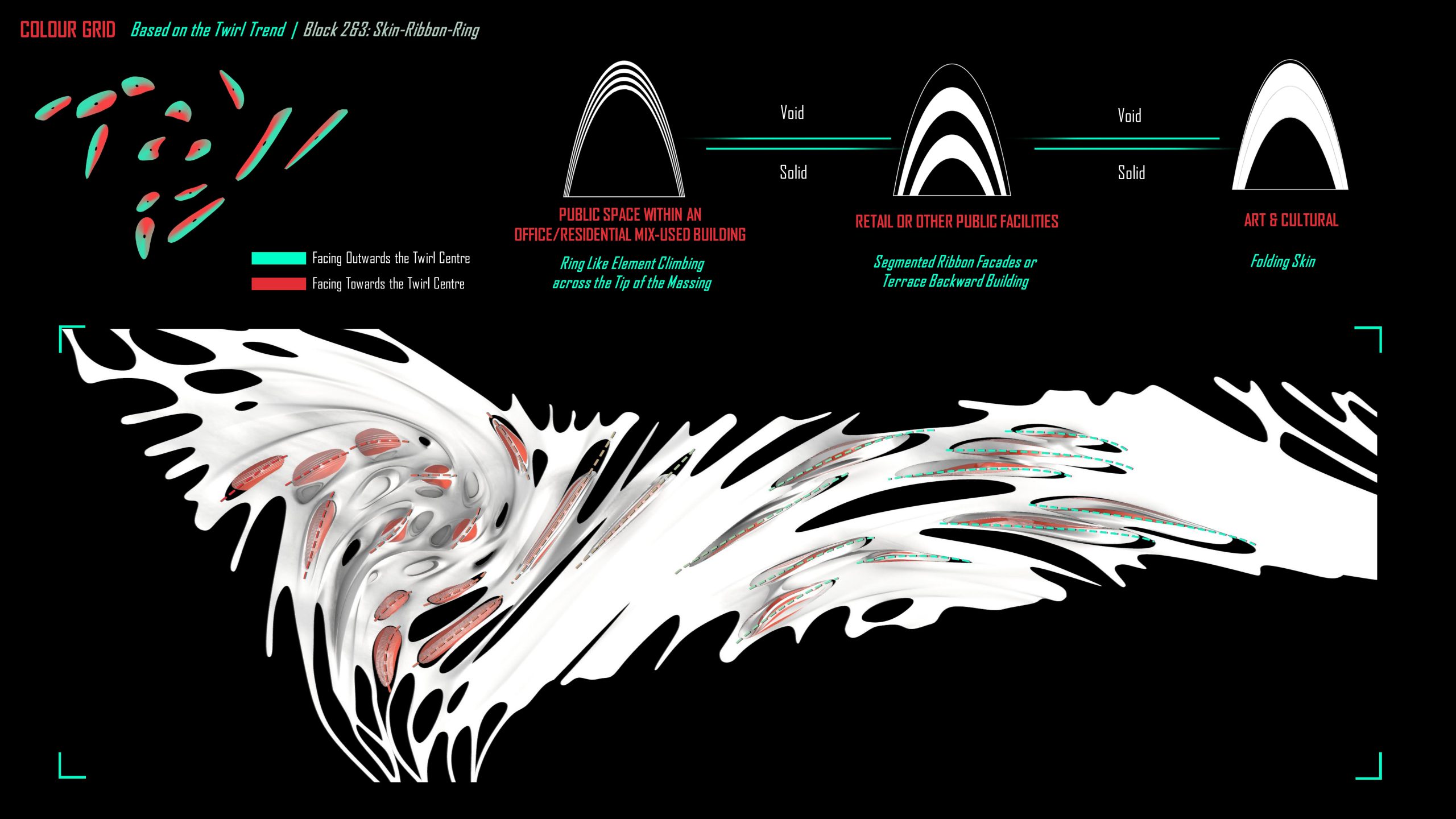
COLOUR GRID
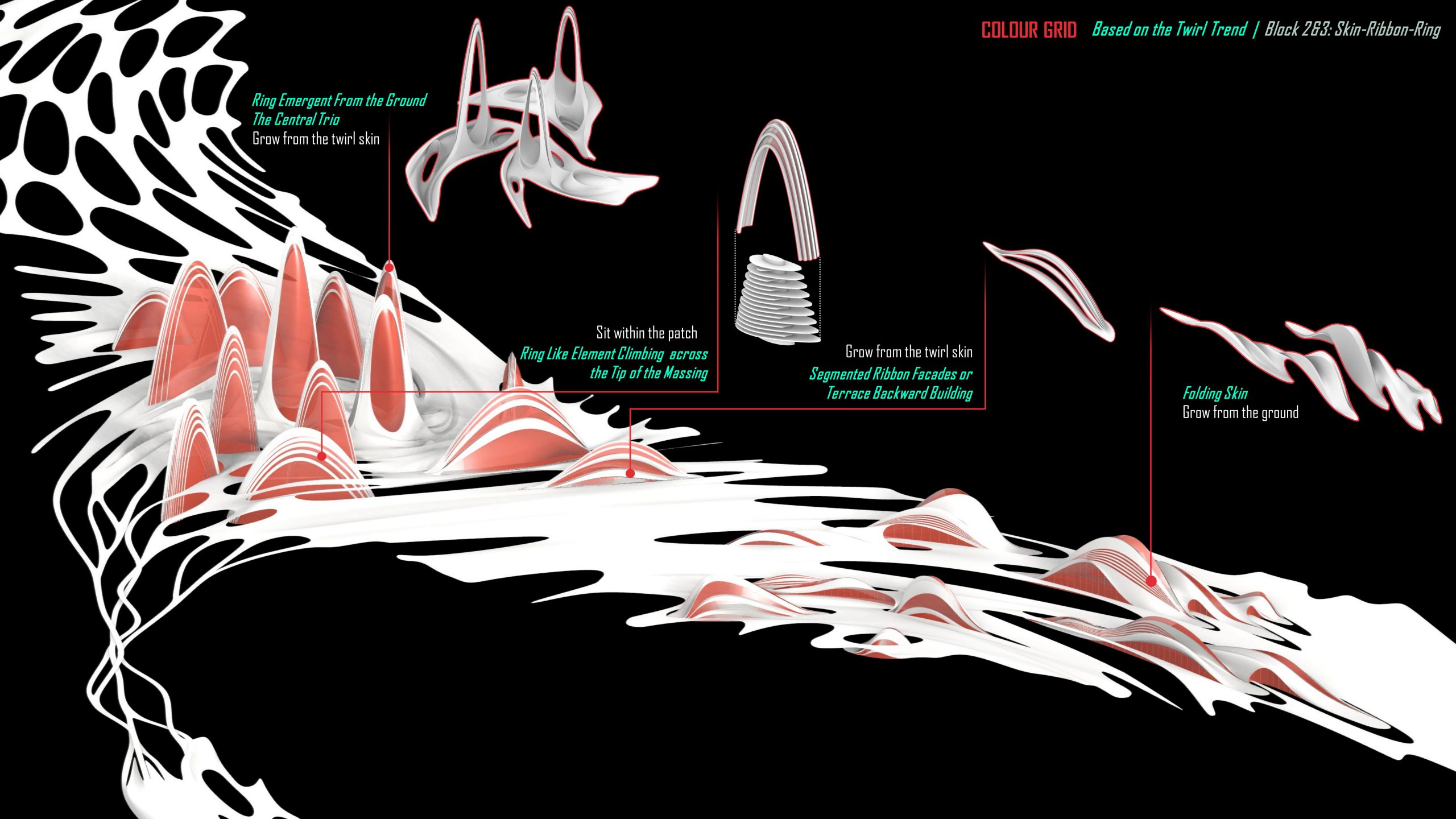
BLOCK 2&3: SKIN-RIBBON-RING
BLOCK 2&3: RETAIL FACADE
For building massing above the twirl skin, we examine the possibility of a series of architectural form languages gradually shifting across different volumes.
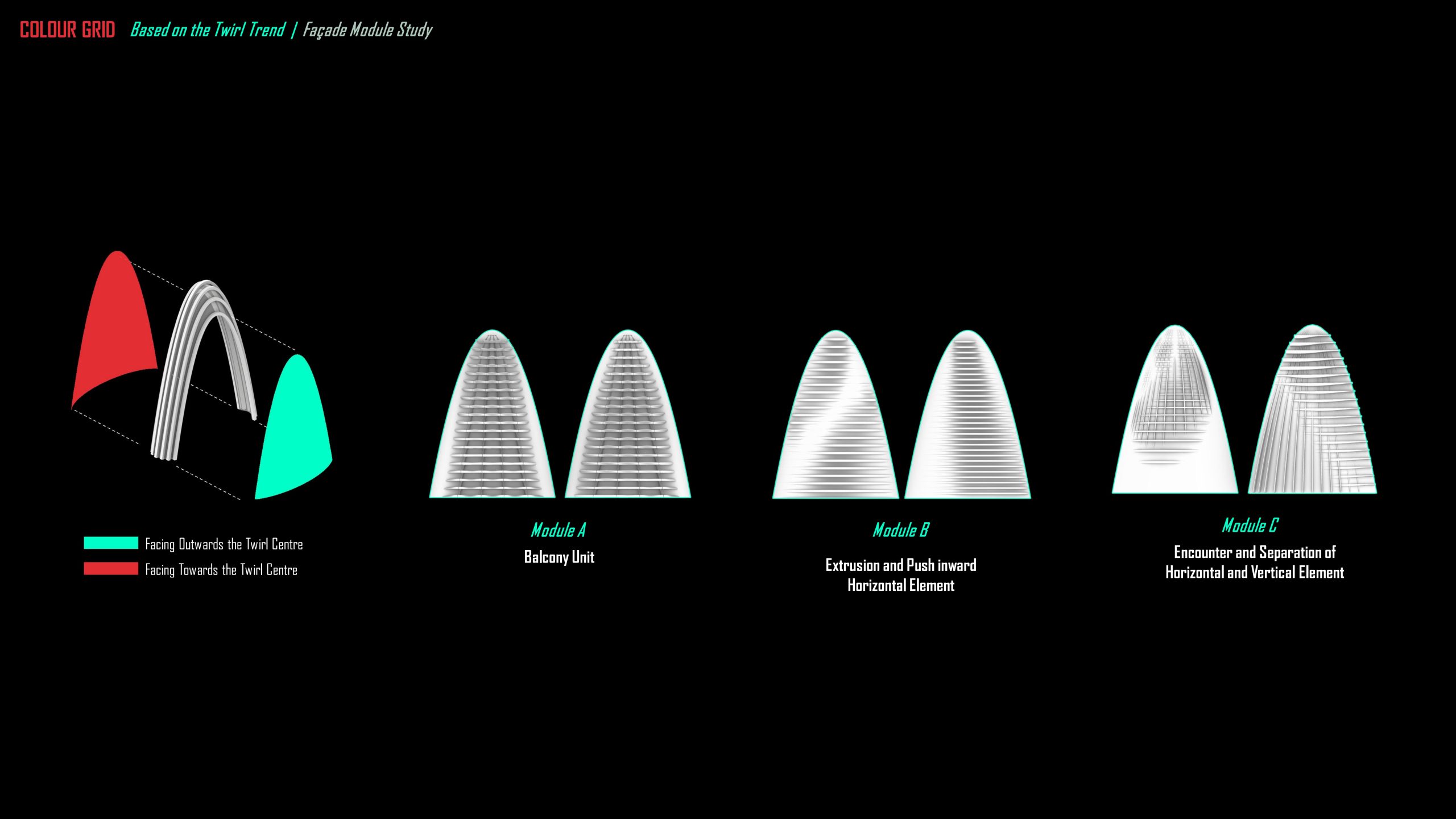
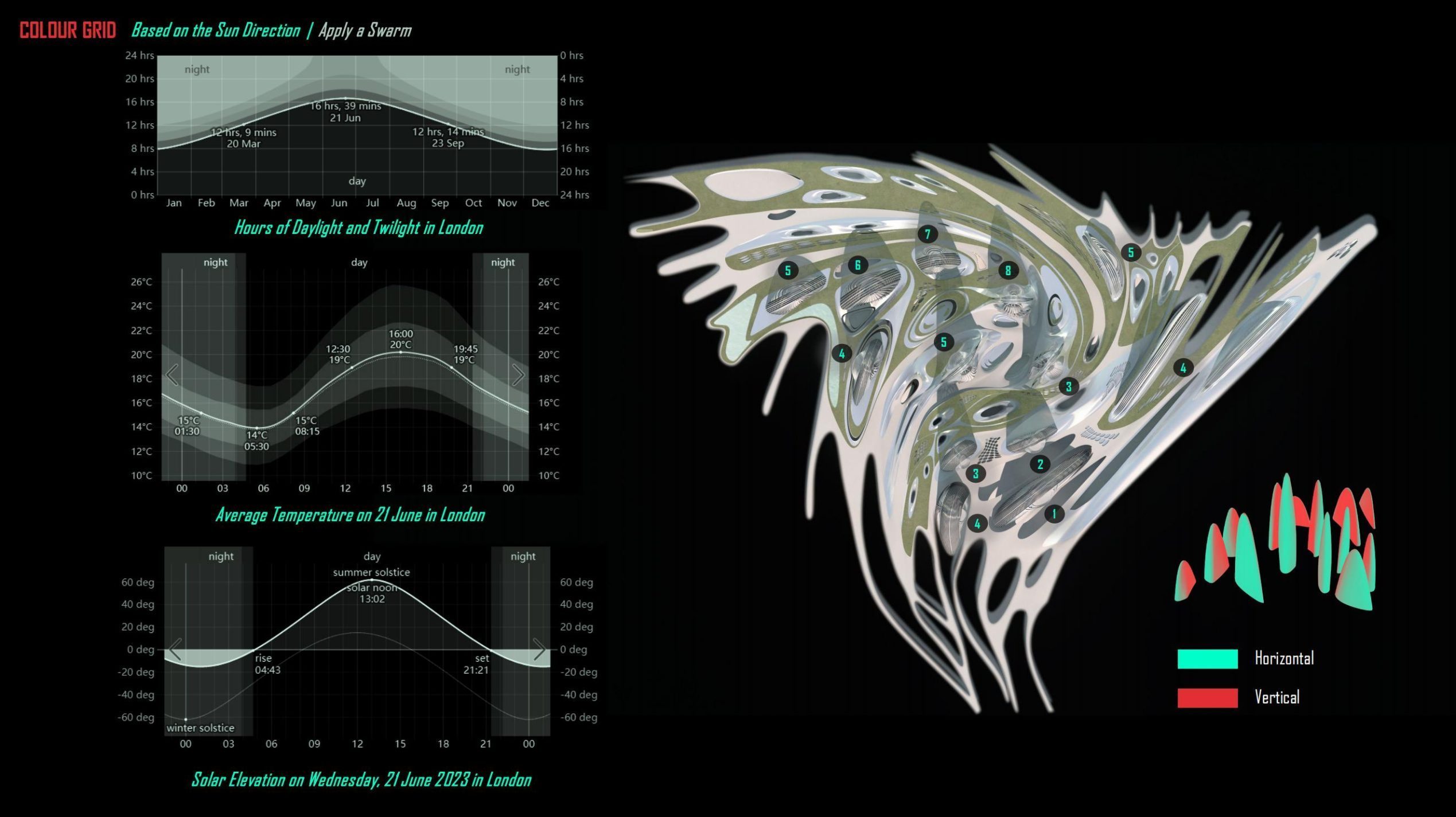
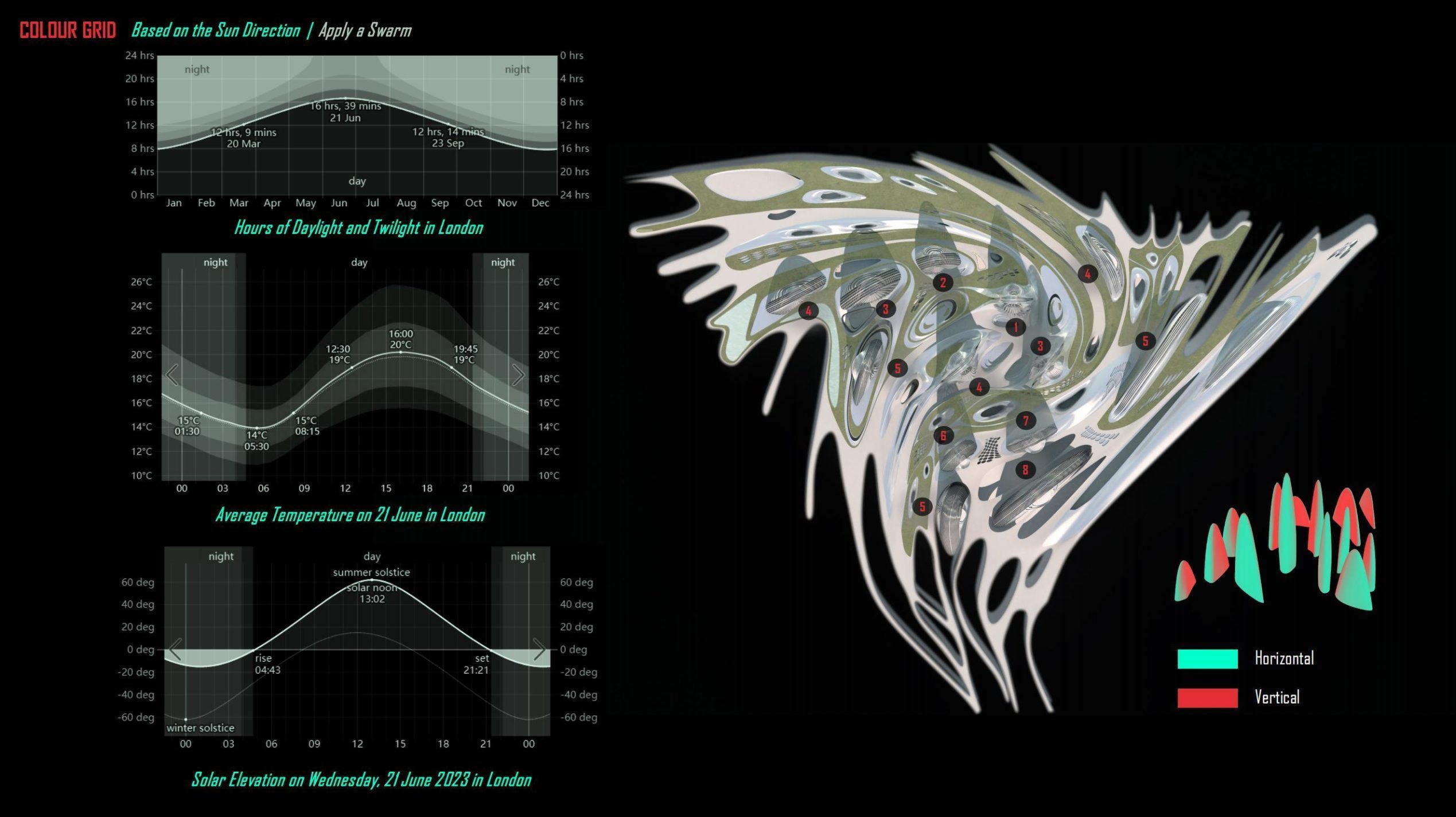
Firstly, we have made a colour code for the building massing in two ways. When based on the twirl trend, the building façade is divided into two according to the centre of the twirl, and the demarcation line between them is in line with the twirl grid. When based on the sun direction, we visualize the effect of sunlight casting on the façade according to its direction, which can be a guide for the depth and density for designing facade elements.
Viewing the colour coding based on the twirl trend in a top view, this trend-following demarcation line provides a top-climbing position for the architectural form in the following design.
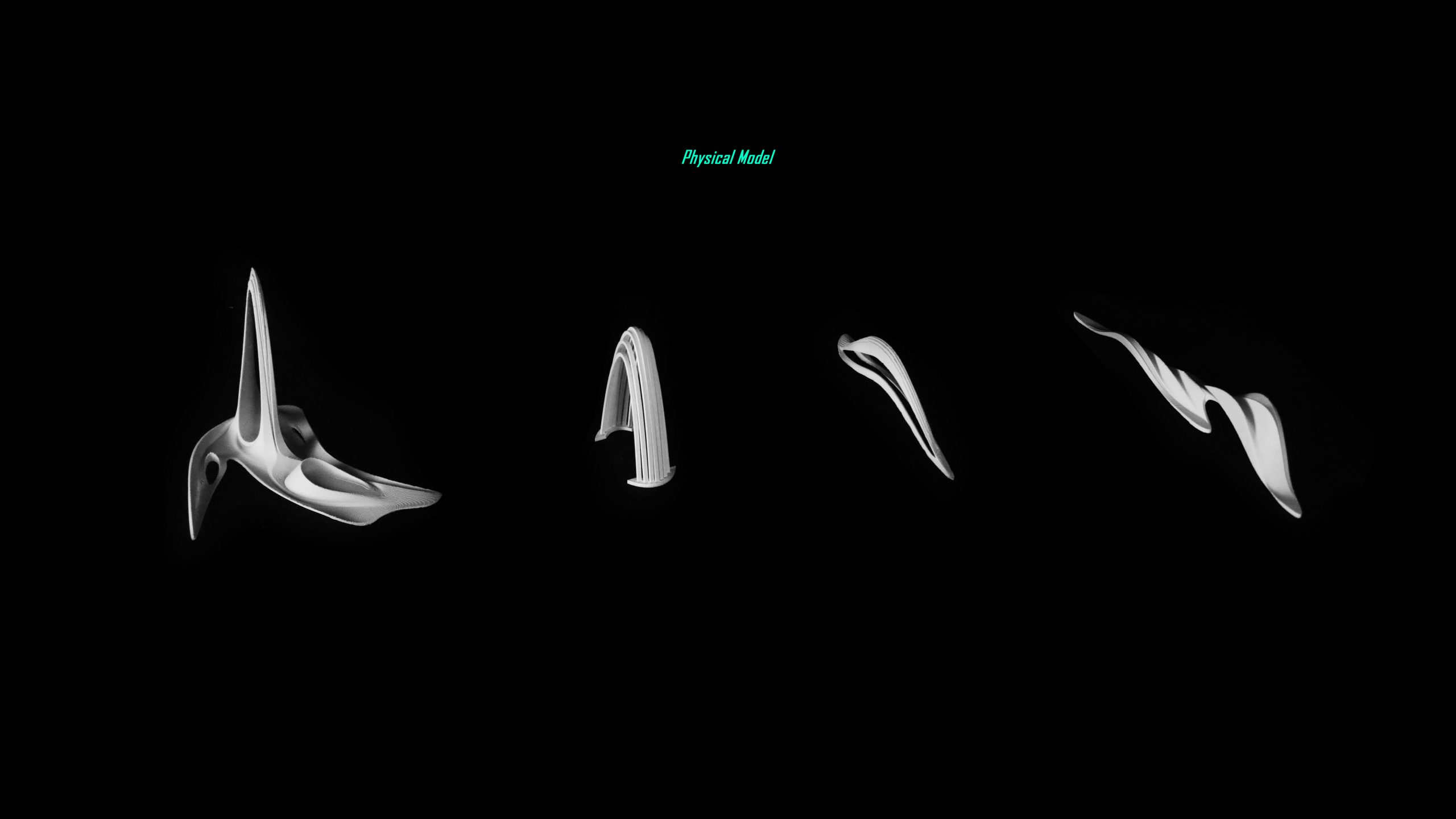
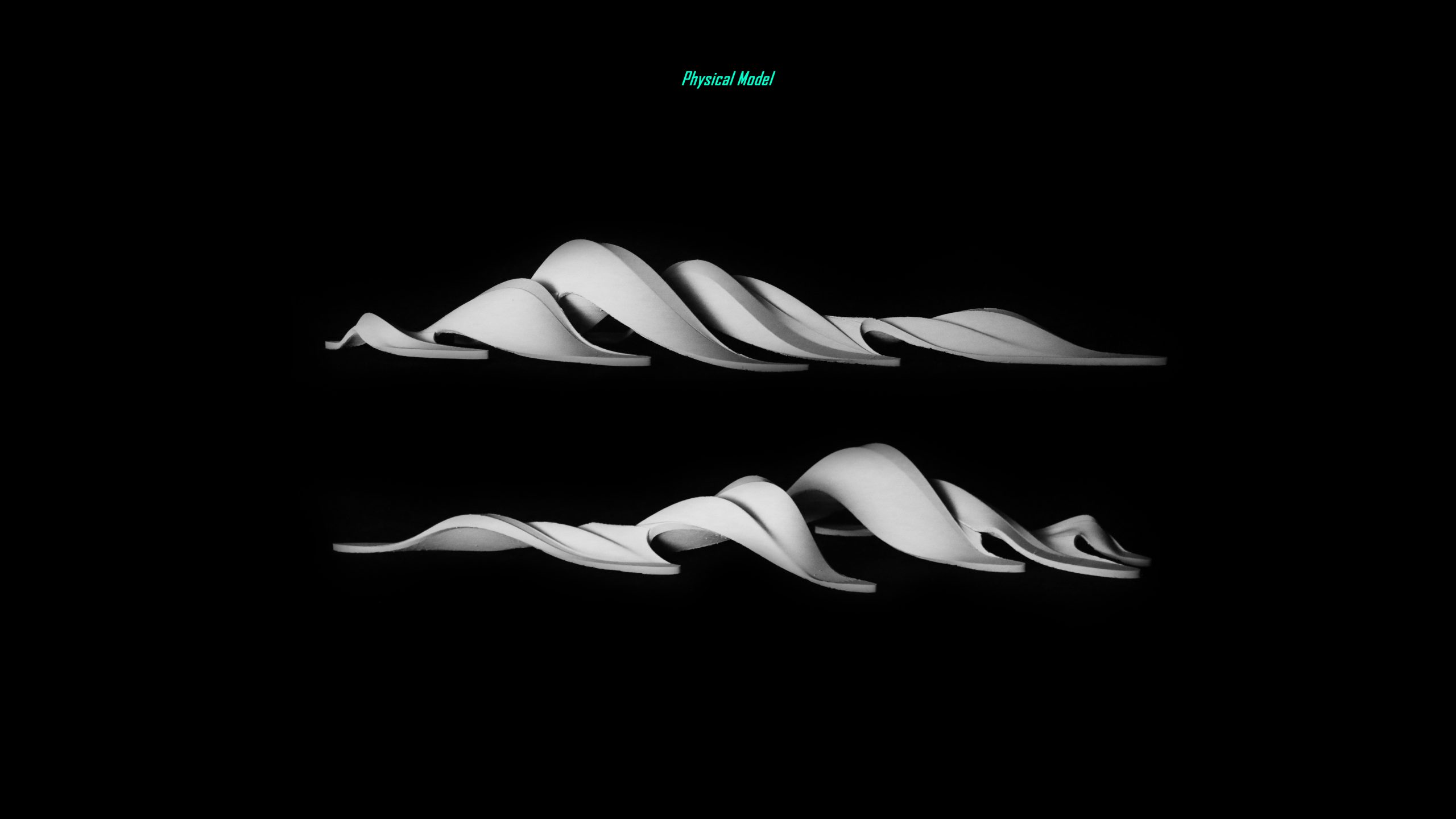
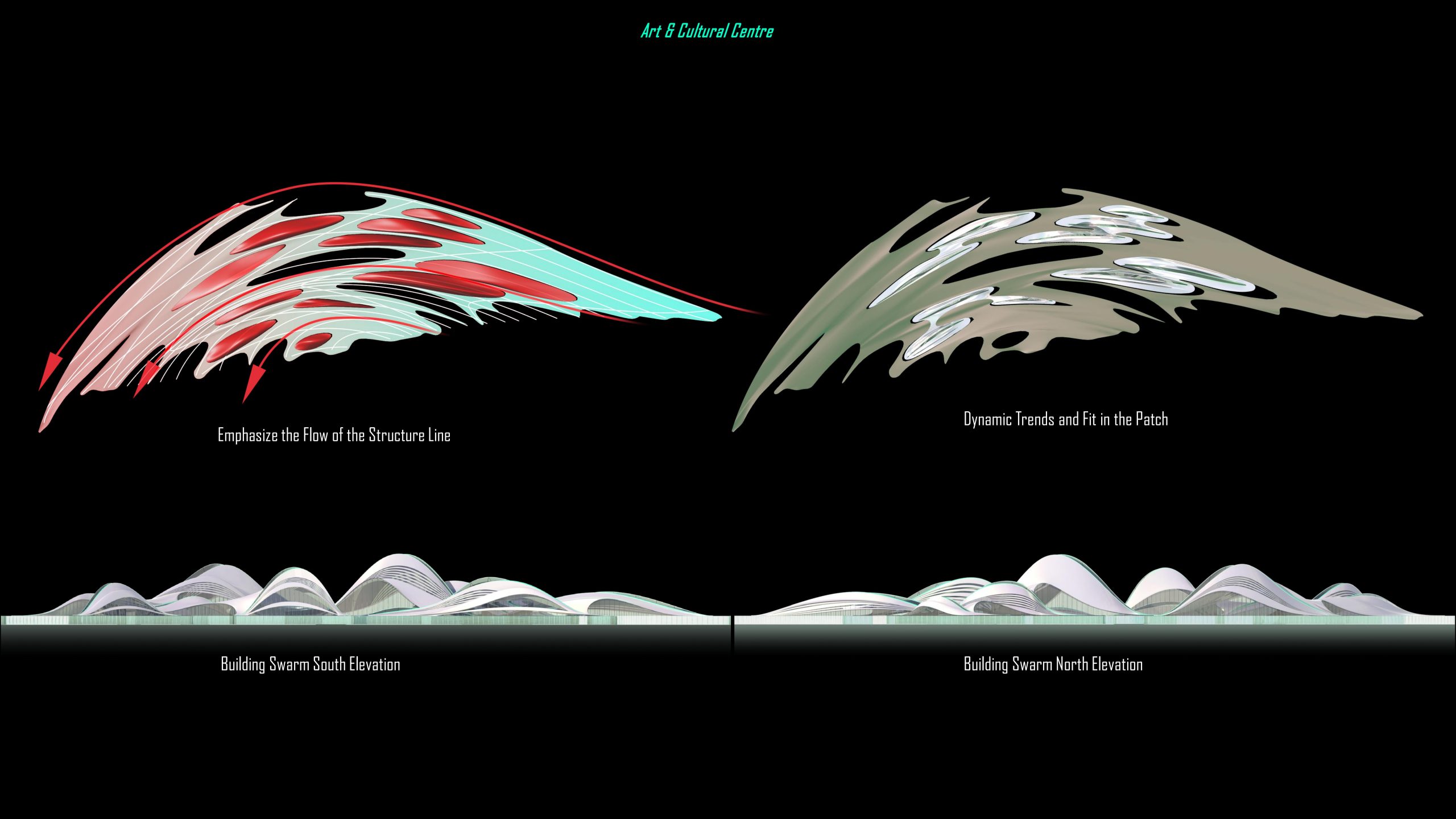
The folded skin that covers the art and cultural centre slowly narrows into a ribbon-like terrace backwards facade, and finally into a ring-like roof façade form.
This series of architectural language can be used to refer to art and cultural public activity buildings, as well as public spaces in office and residential buildings, such as the skyscraper atriums or rooftop gardens, and so on.
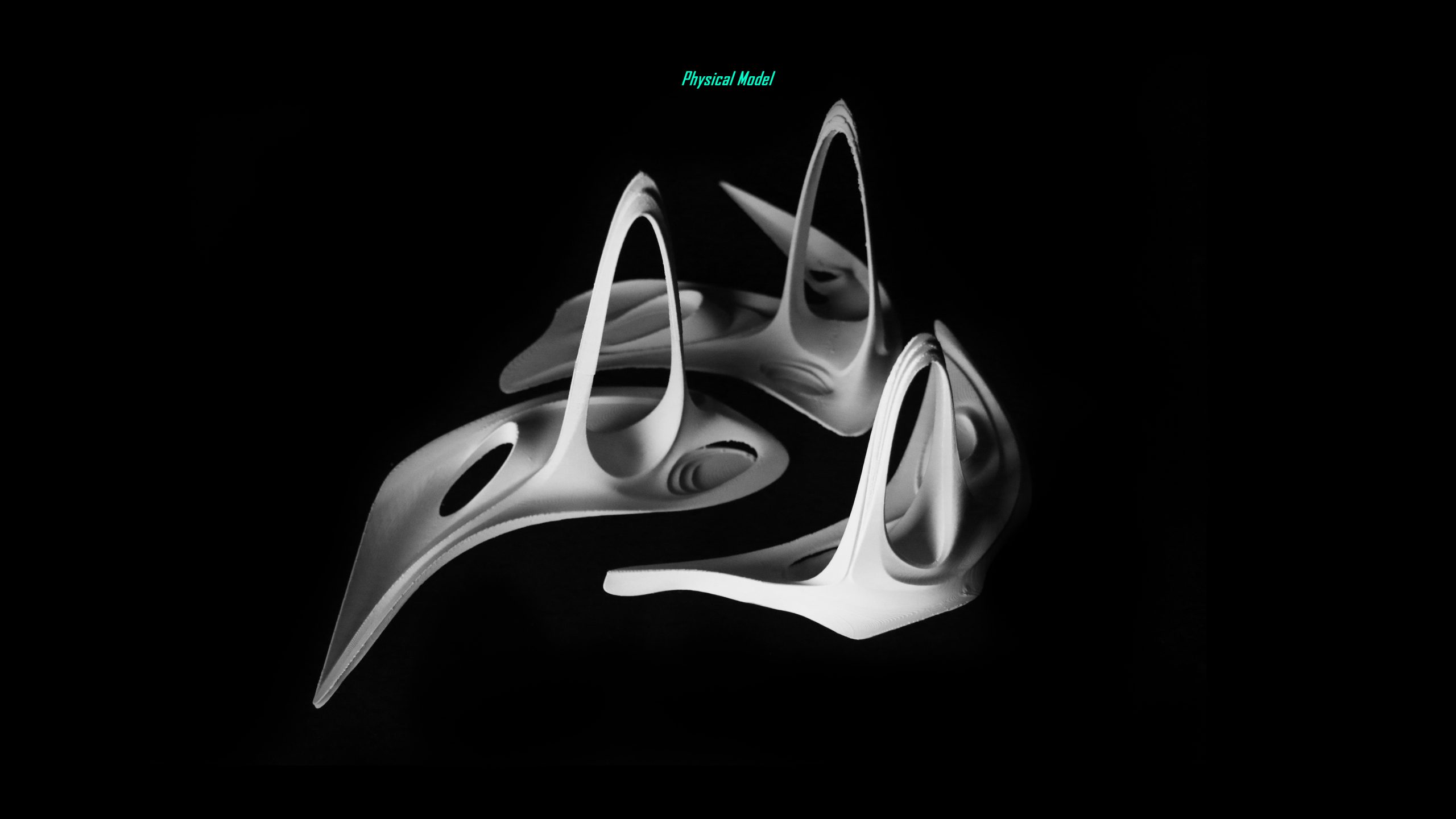
Especially, for the trio of towers at the centre, the ring is likewise creased and emerges from the twirl skin, influencing the greenery and pedestrian walkways while enhancing orientation and spiralling centrally.
For the retail façade beneath the twirl skin podium in the junction area, we use diamond grid pattern with scale and depth difference.
And façade along waterscape retail in block3, we use a similar grid but horizontally emphasize pattern aligned with the linear feature in this area. The opening of the façade responds to the sun direction from west to east.
FACADE MODULE
MODULE B
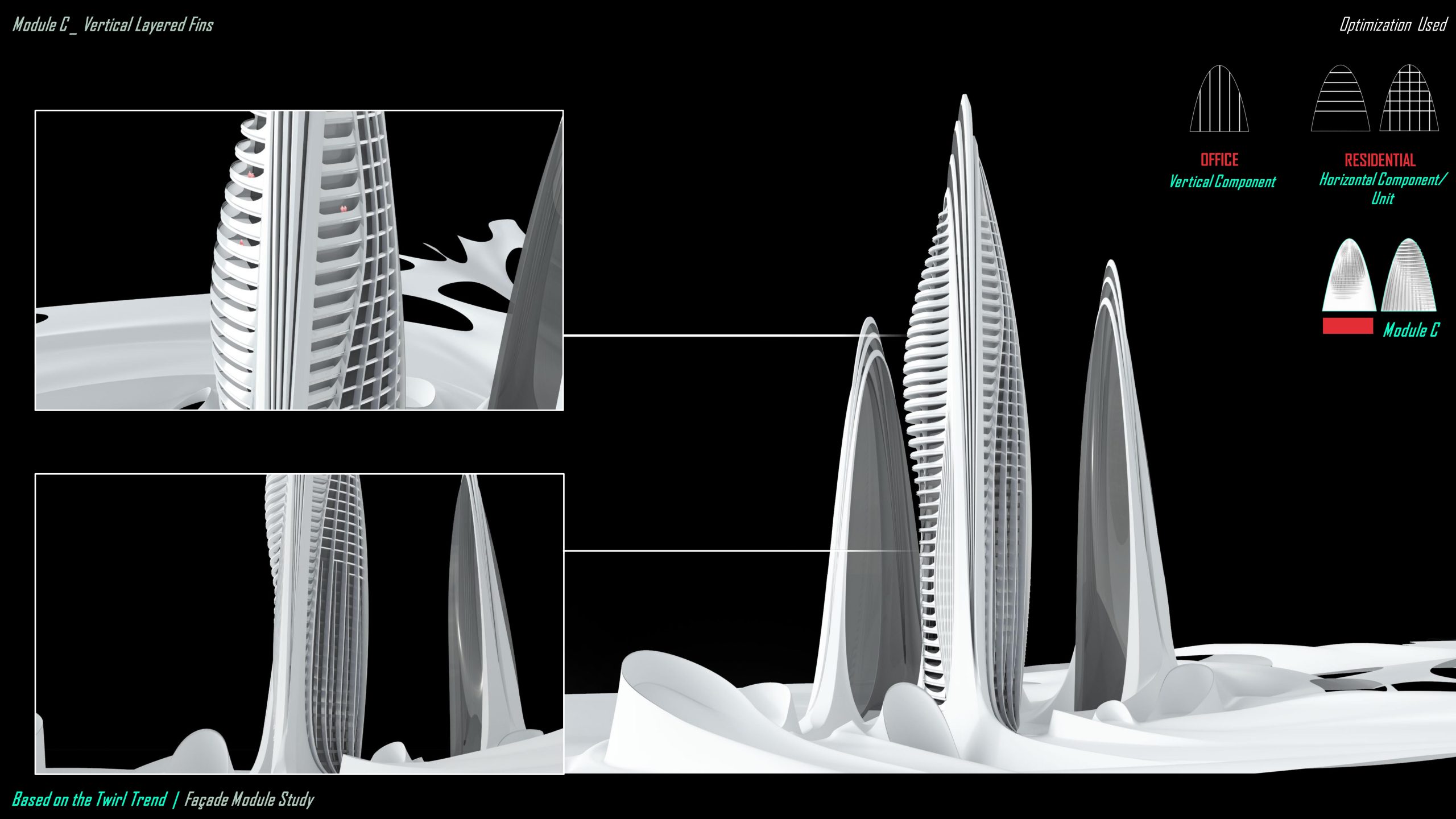
MODULE C
APPLY IN A SWARM
ANIMATION & CROSS SECTION
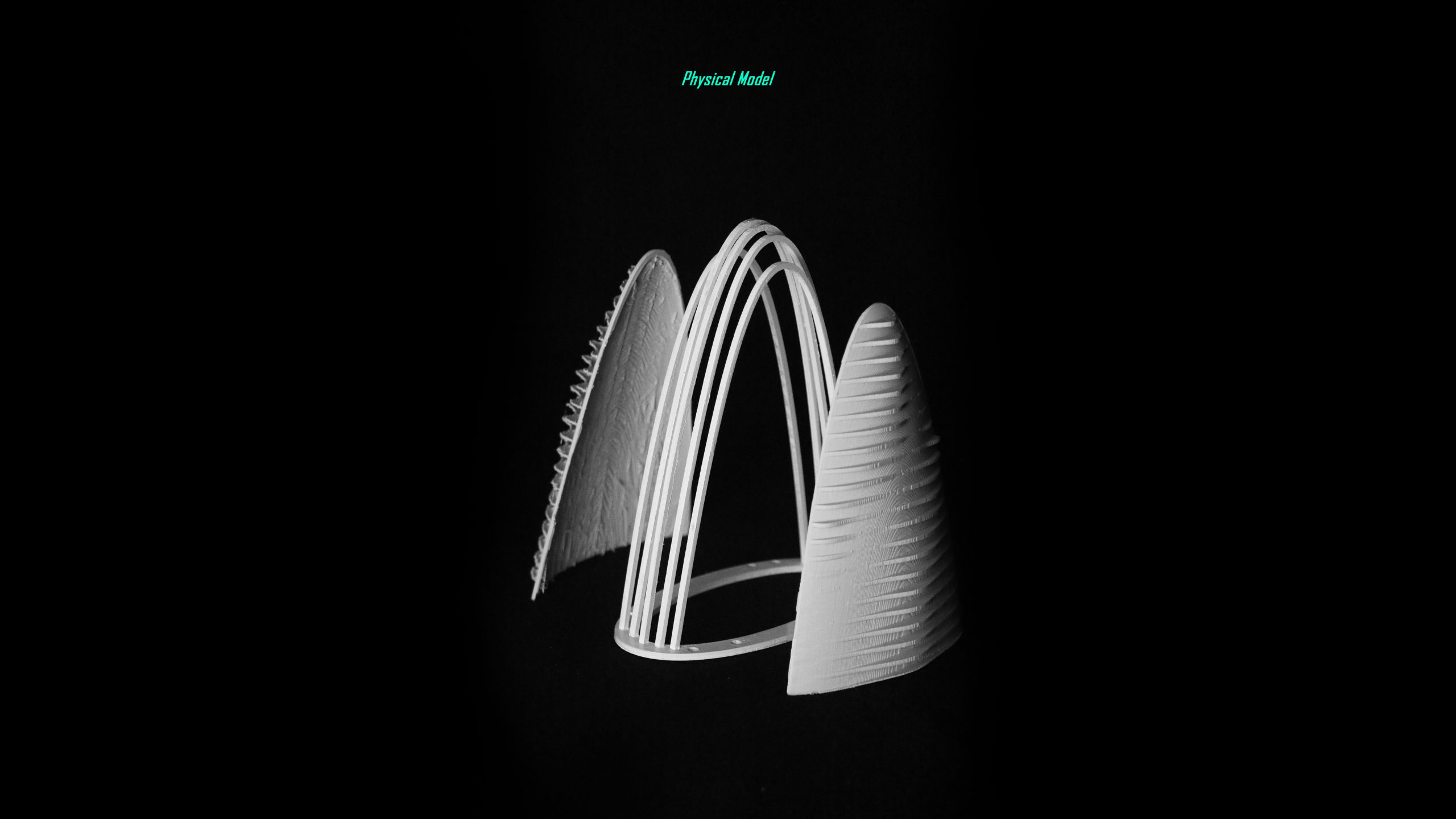
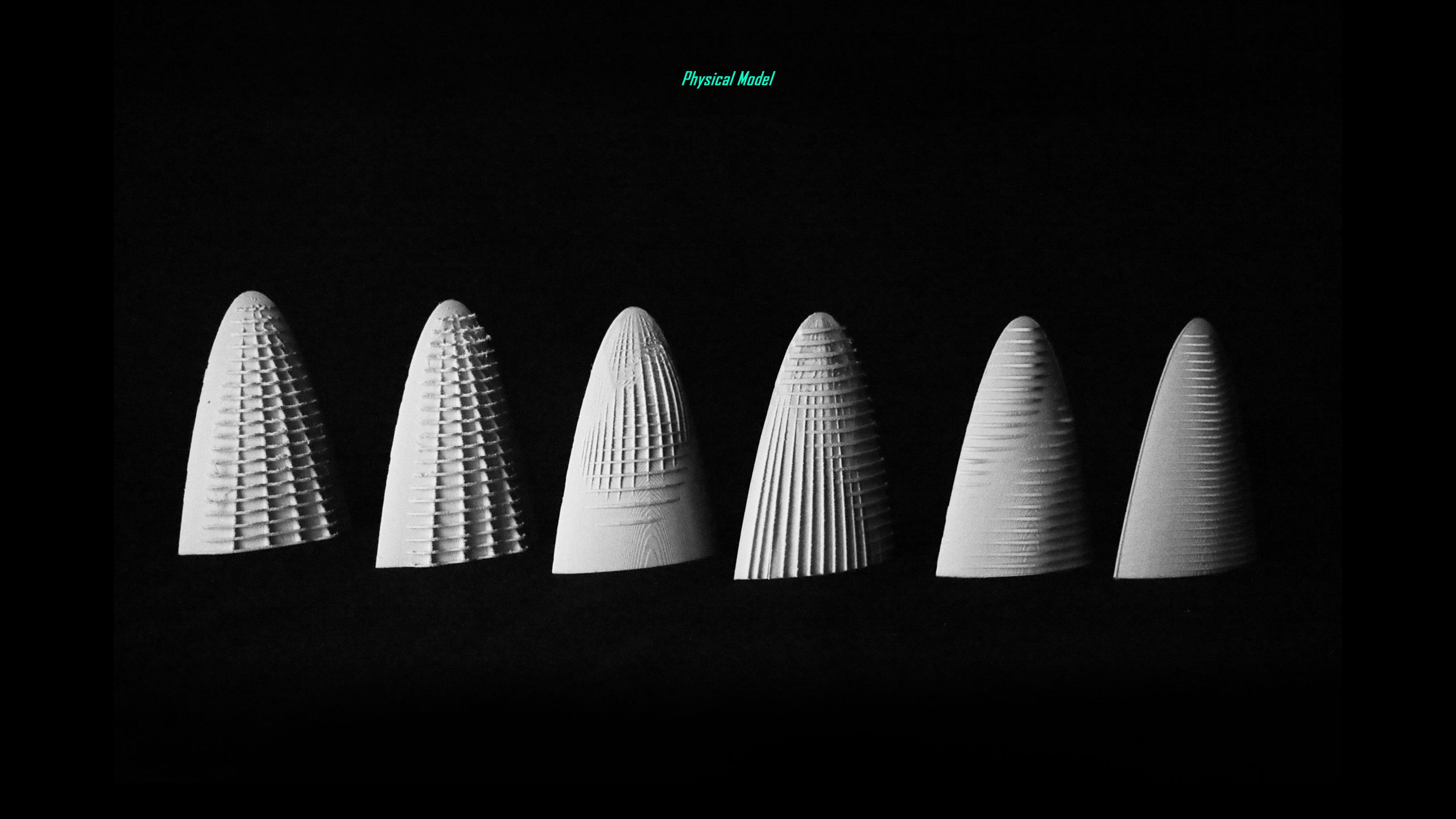
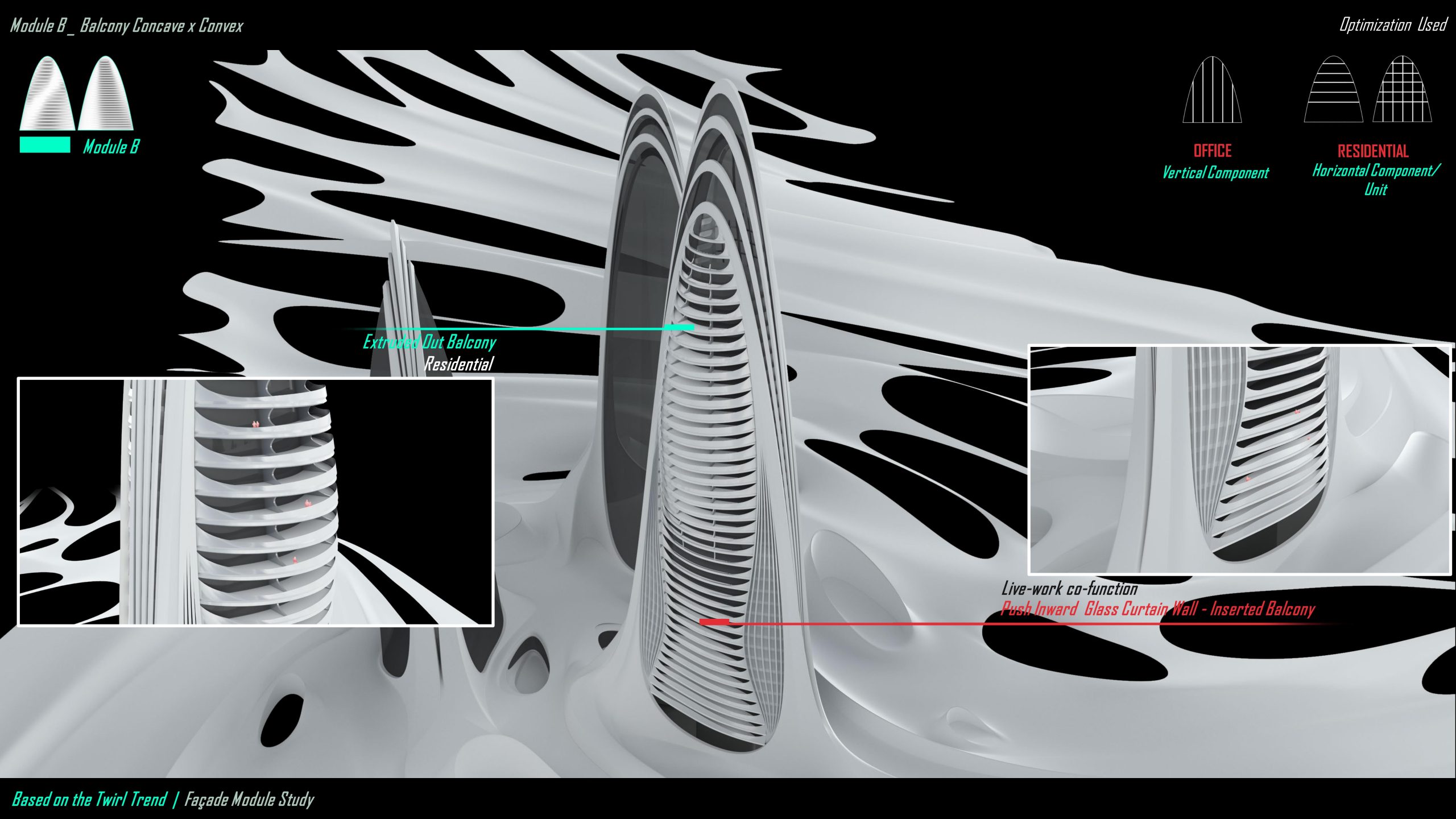
We try to use the same language to distinguish the internal and external facades, we can strengthen their orientation by applying different facade modules on different sides. We have studied three different forms of modules and can choose different combinations to observe their features on the prototype model.
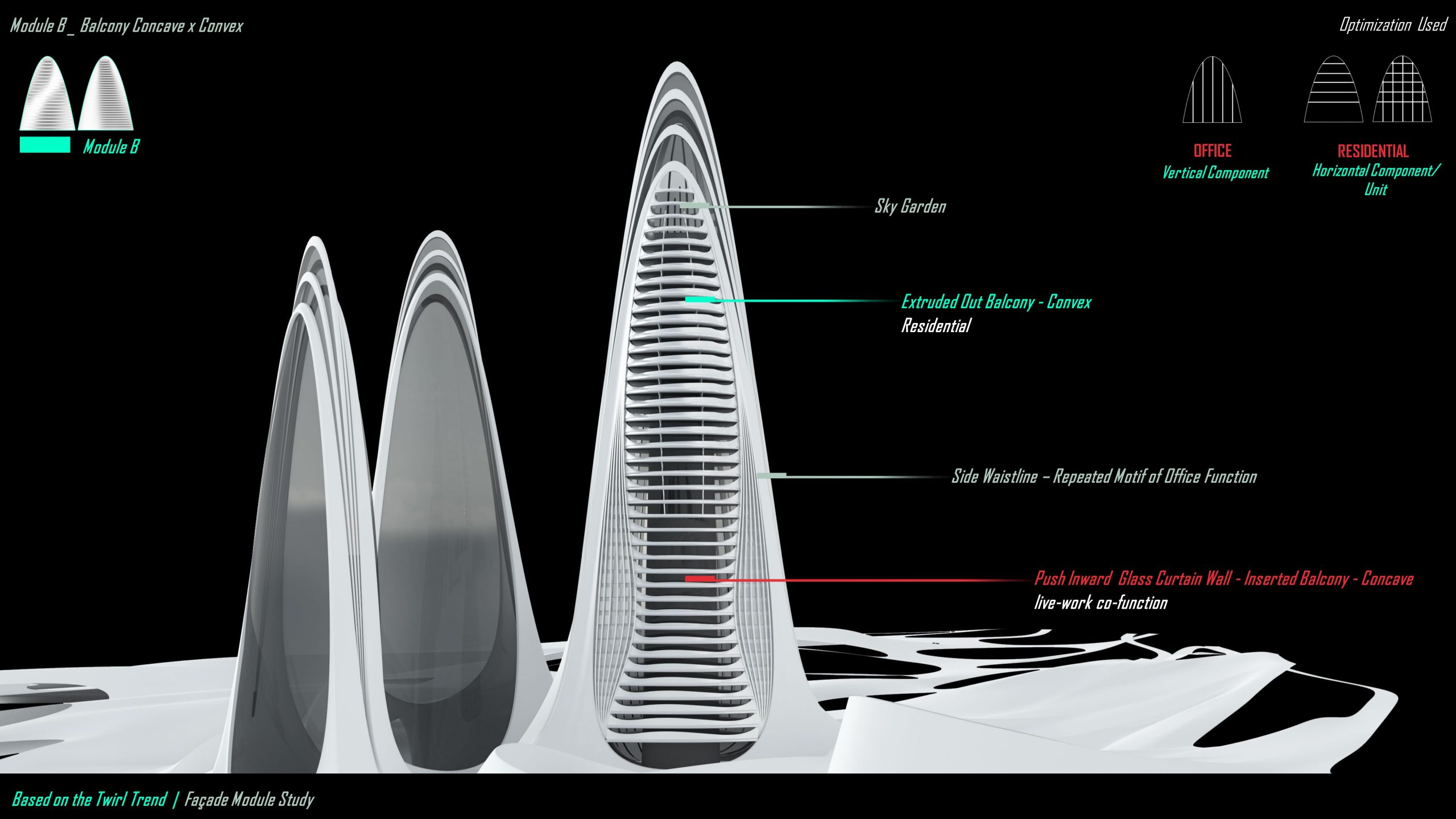
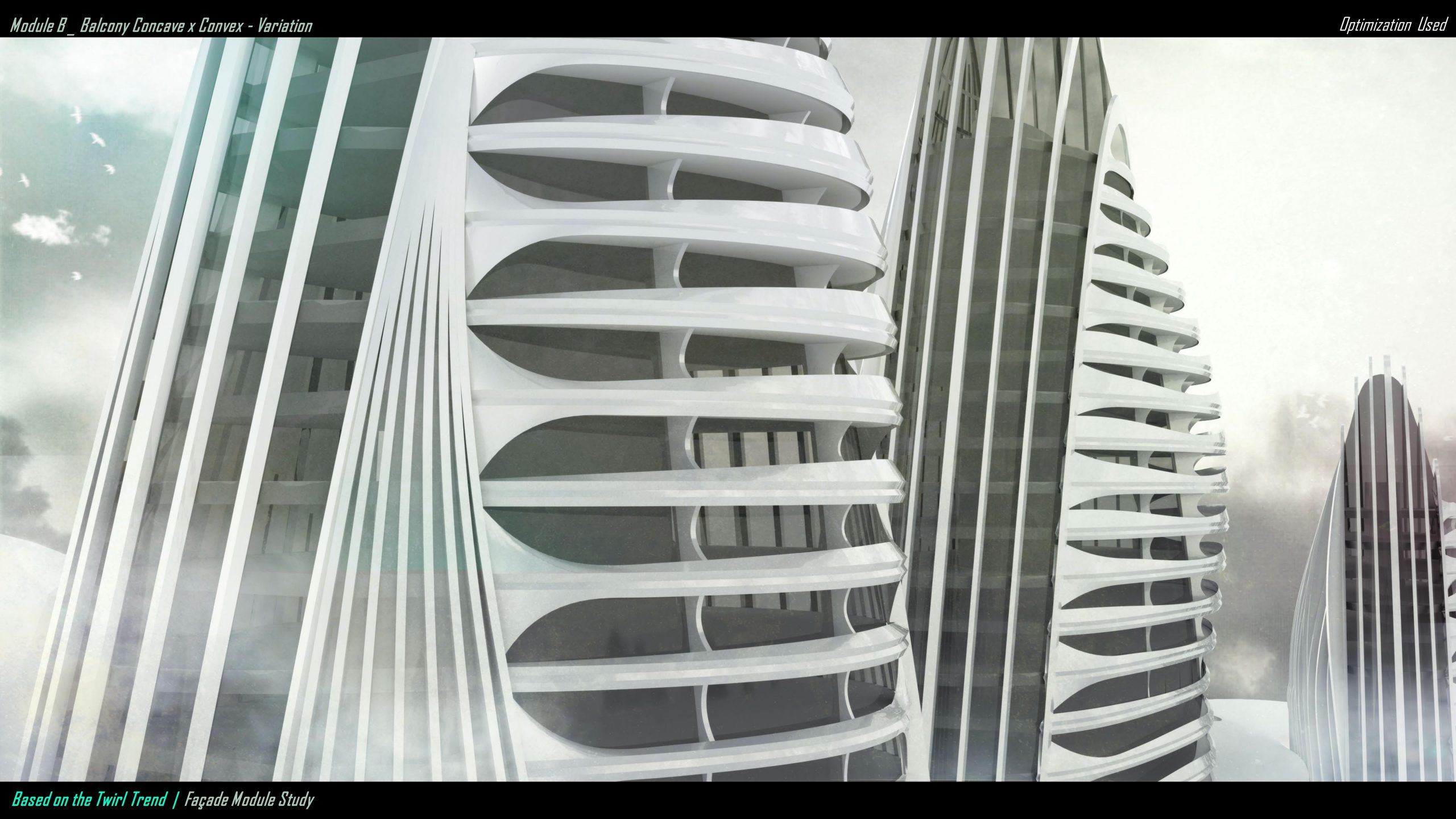
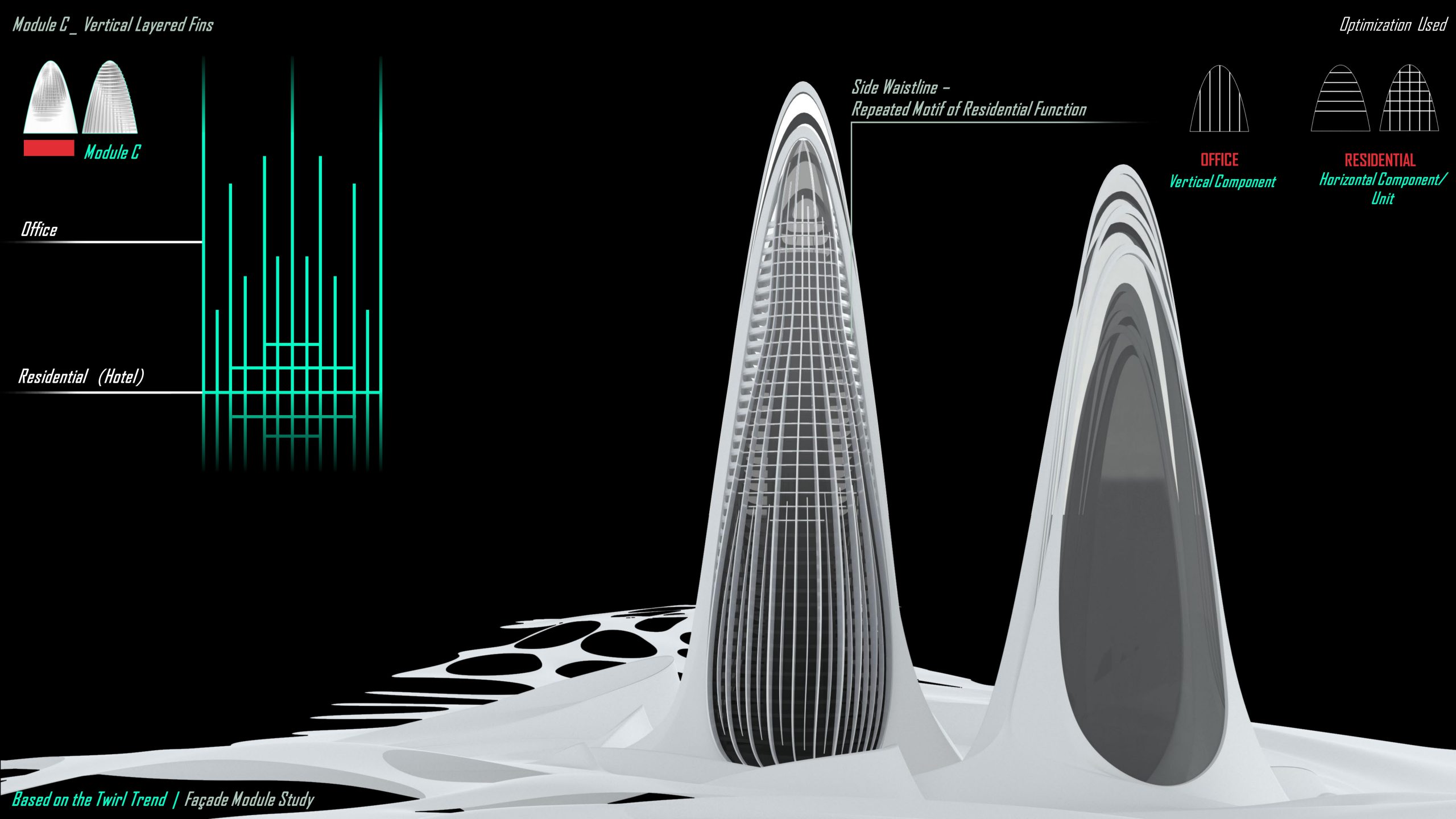
We attempted several and observed that with simpler elements we build better harmony. Thus, we choose modules B and C for early application. However, we observe the lack of dramatic distinguishment between the two modules and their functional imply. So after a few optimization iterations of two modules, we came out with the latest attempt of them both.
For module B — the mainly horizontal element facades, we tried to blend concave and convex balconies to distinguish purely residential and live-work co-function. The side waistline with vertical fines is a repeated motif of the office function, showing a mixed-use possibility of the bottom part.
From the profile, the glass edge of the convex balcony and the floor edge of the concave balcony are aligned with the original form. The extrusion position will align with our functional division from elevation.
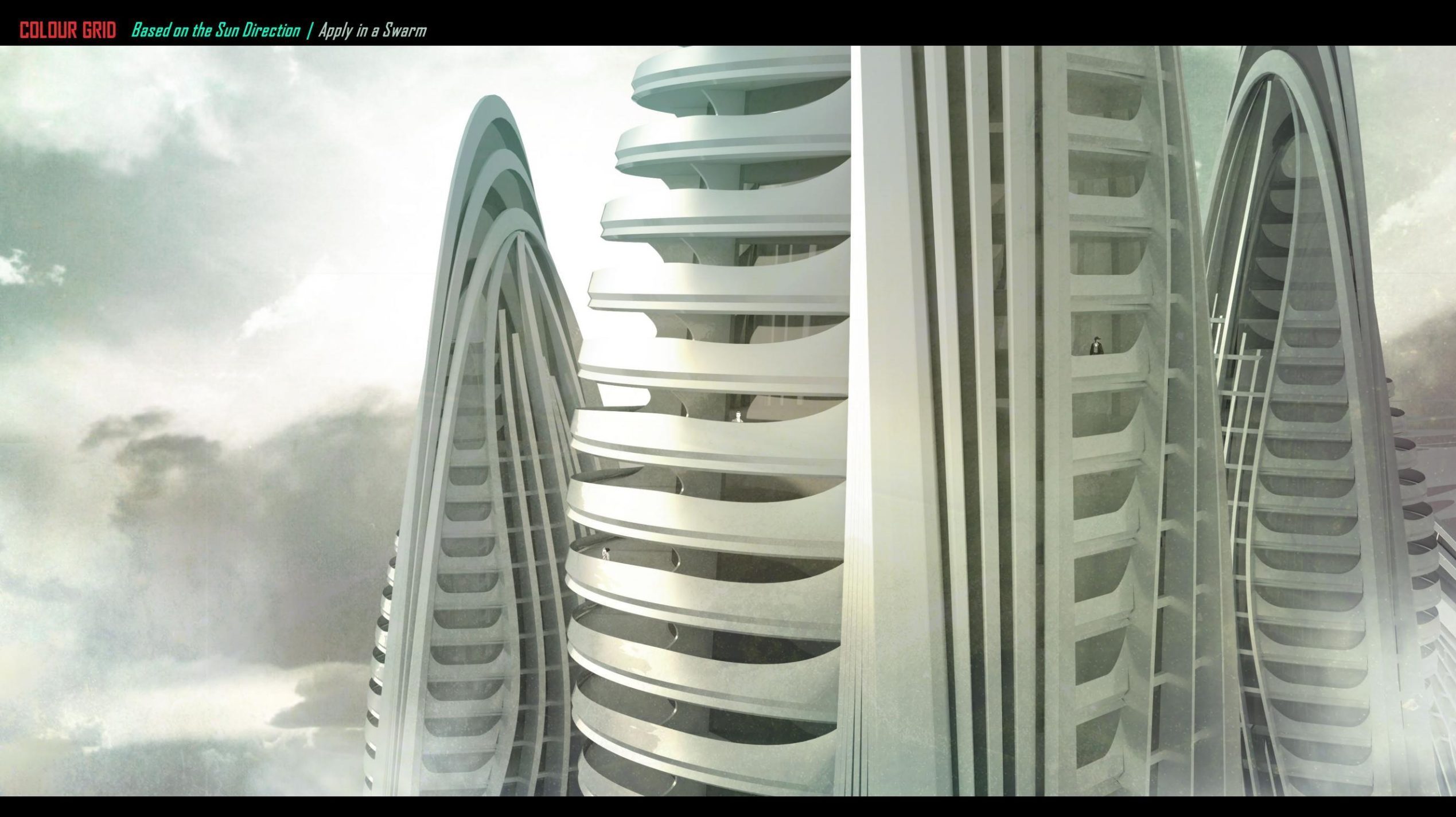
For the mainly vertical module C, we tried layered fins to align with the contour, and where the layer ends can result in a curvature, emphasizing the vertical functional distinguishment among the building swarms. And where the horizontal element encounters, there implies a hotel section for the use. Again the side balconies are repeated motifs of the opposite. And the fins make the façade more solid based on the depth when observed among different angles.
The number /depth /contour of fins can be parametrically related to sun direction.
We pick out a time sample of the roughly hottest time of the longest daylight hours date in London and evaluate the shadow with the angle of each side of the façade. The number shows the order of depth of extrusion compared among the chunk. And the order of the opposite façade will flip entirely.
From above the twirl skin, pedestrians can access the podium beneath via sunken plaza or aperture-like entrance vertically downwards. While podiums are connected with bridges and build an individual connection themselves. The vehicle paths are below the second layer twirl surface on the actual ground level.
BLOCK 3
BLOCK 4
ANIMATION & RENDERS
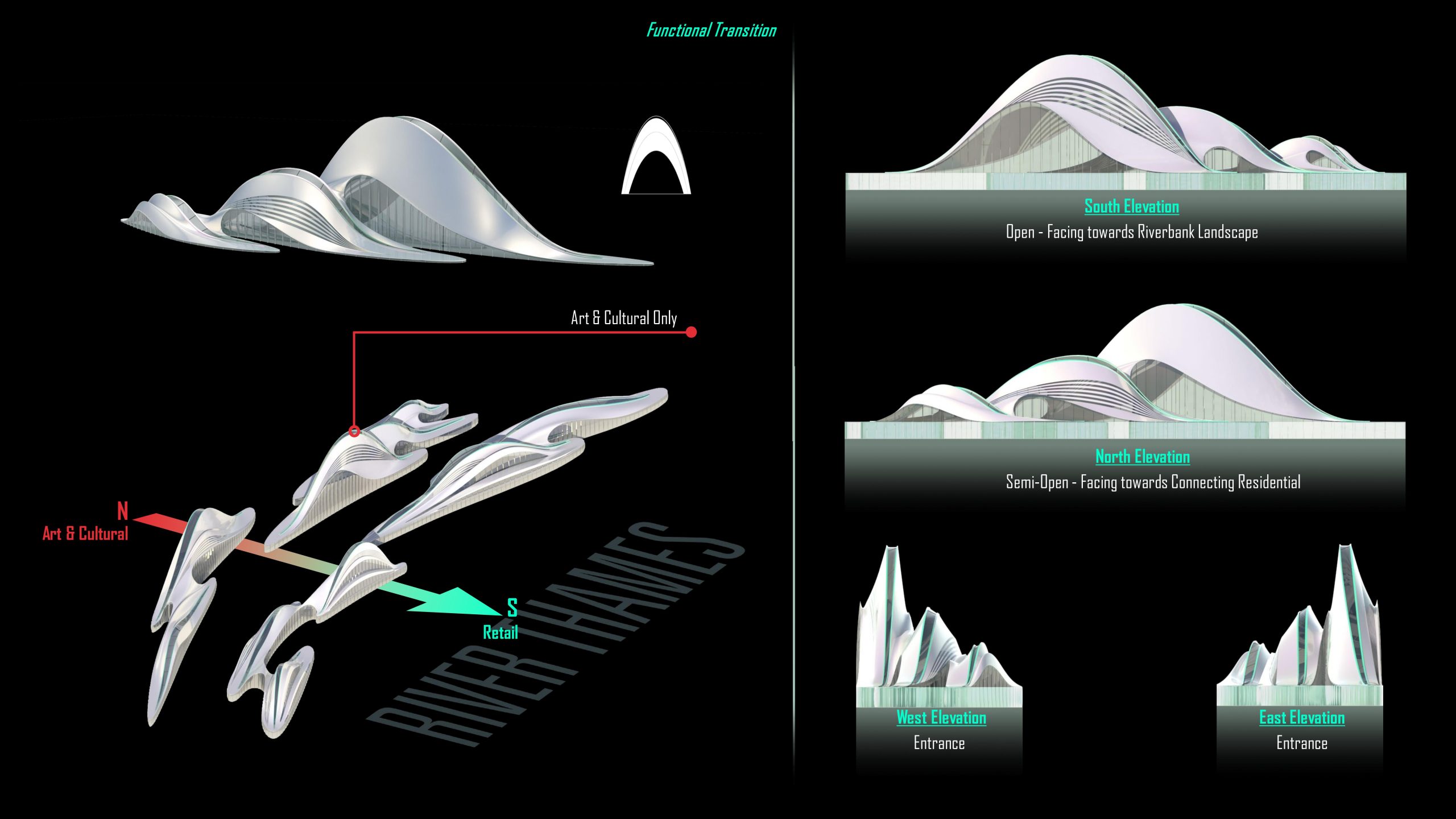
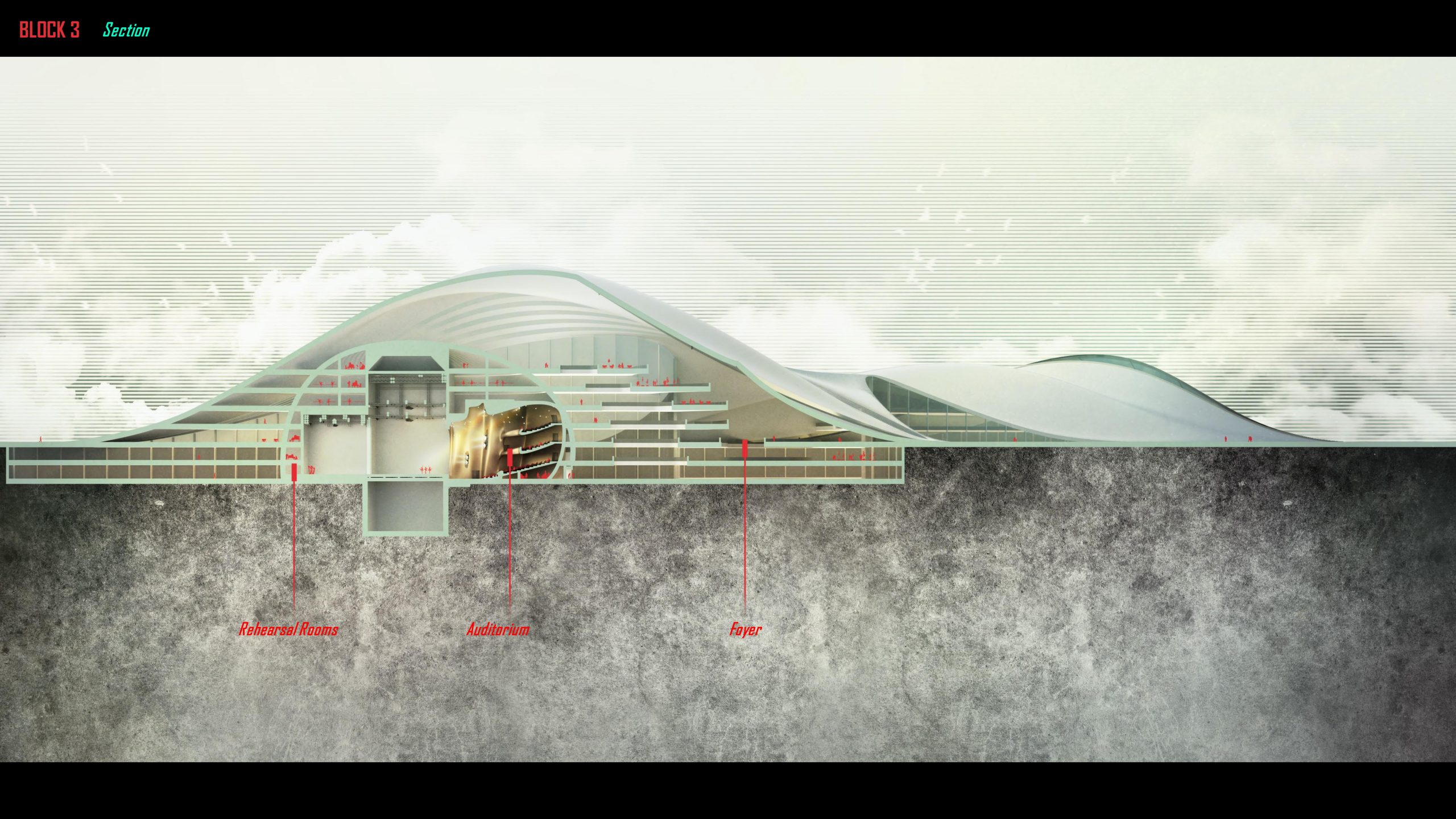
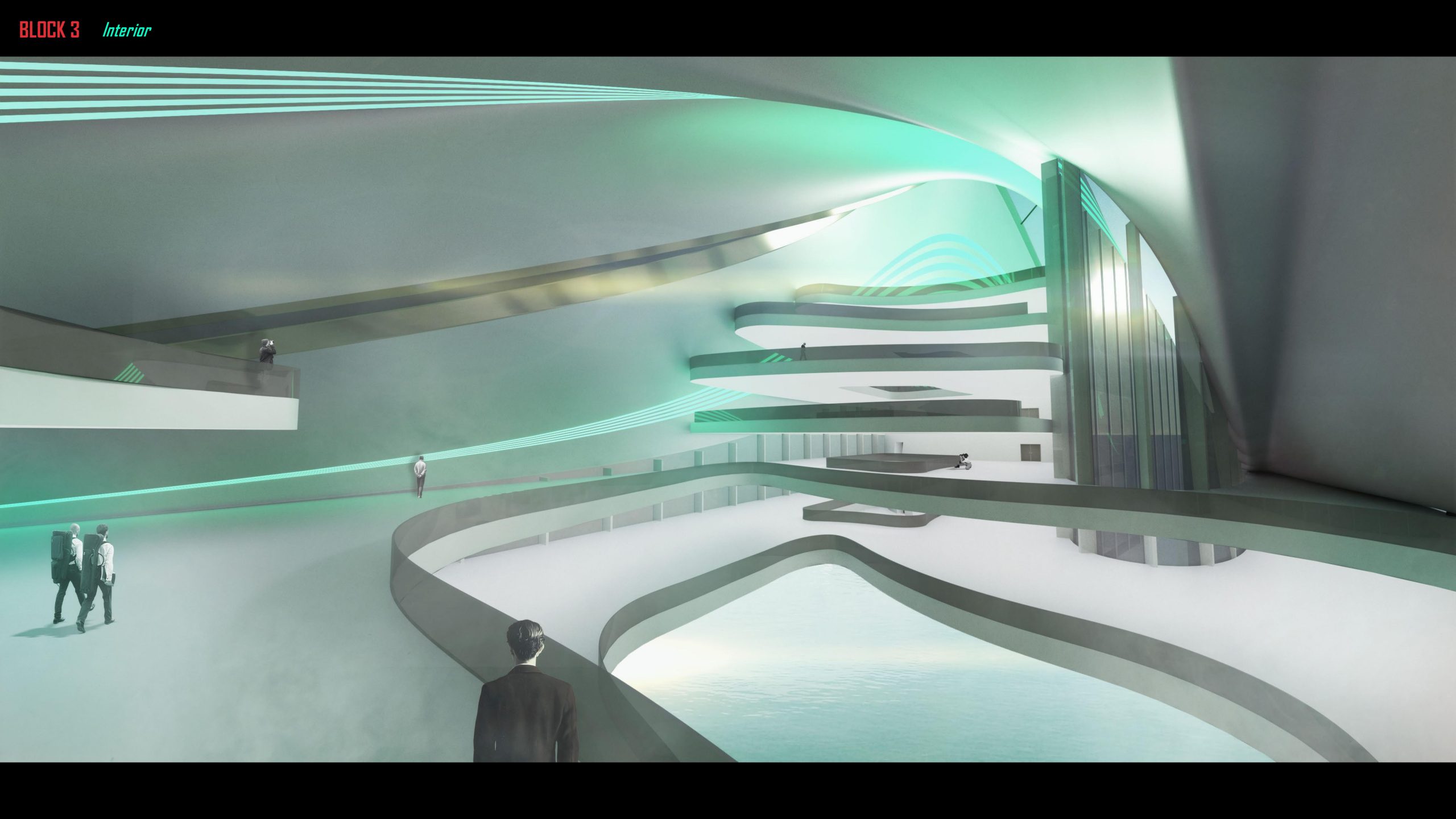
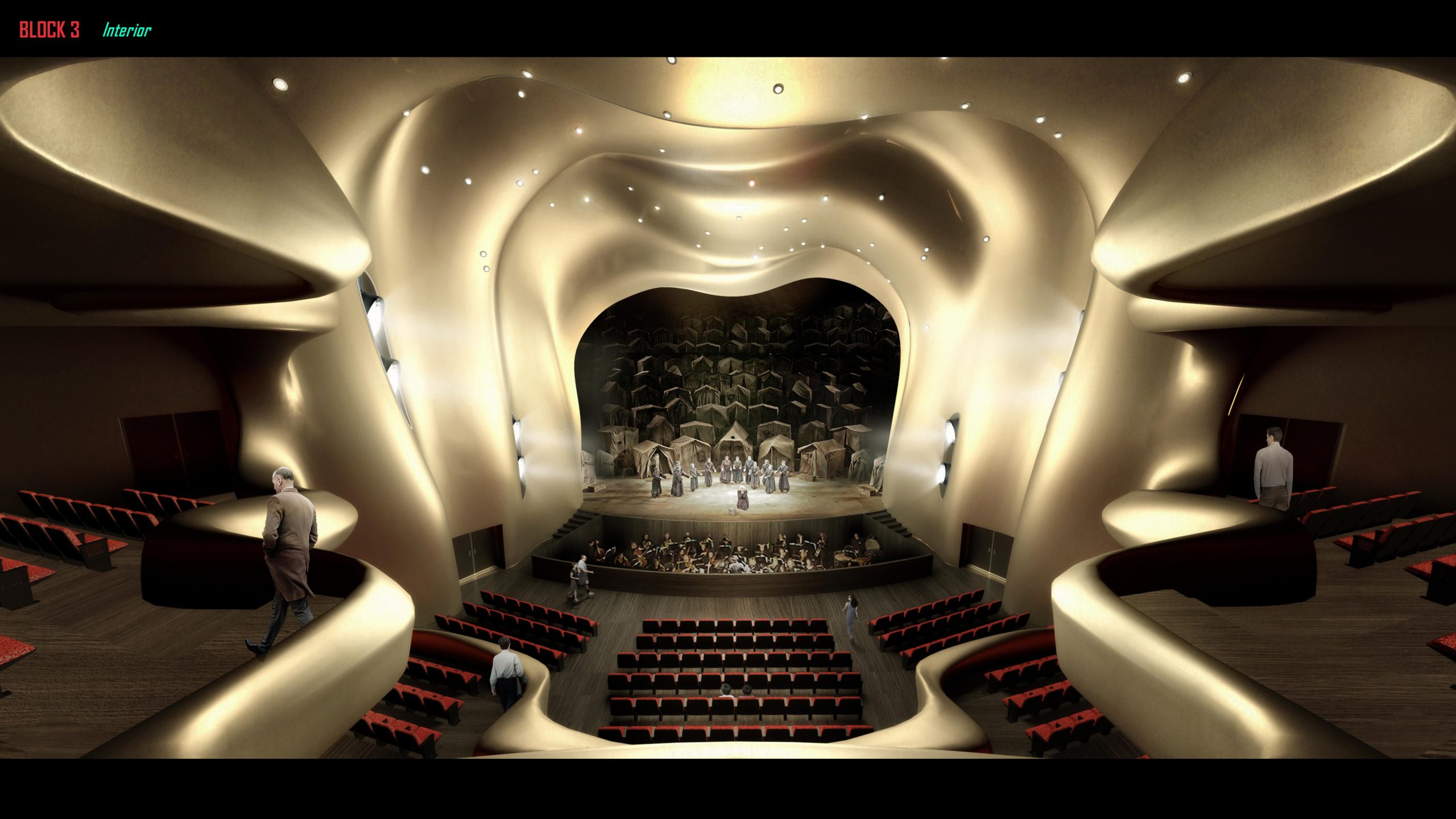
For the art and culture centre, it gradually transfers into a stretched-out and lowered gesture. We would like to connect the slender massing group by group to enhance the trend of the flow.
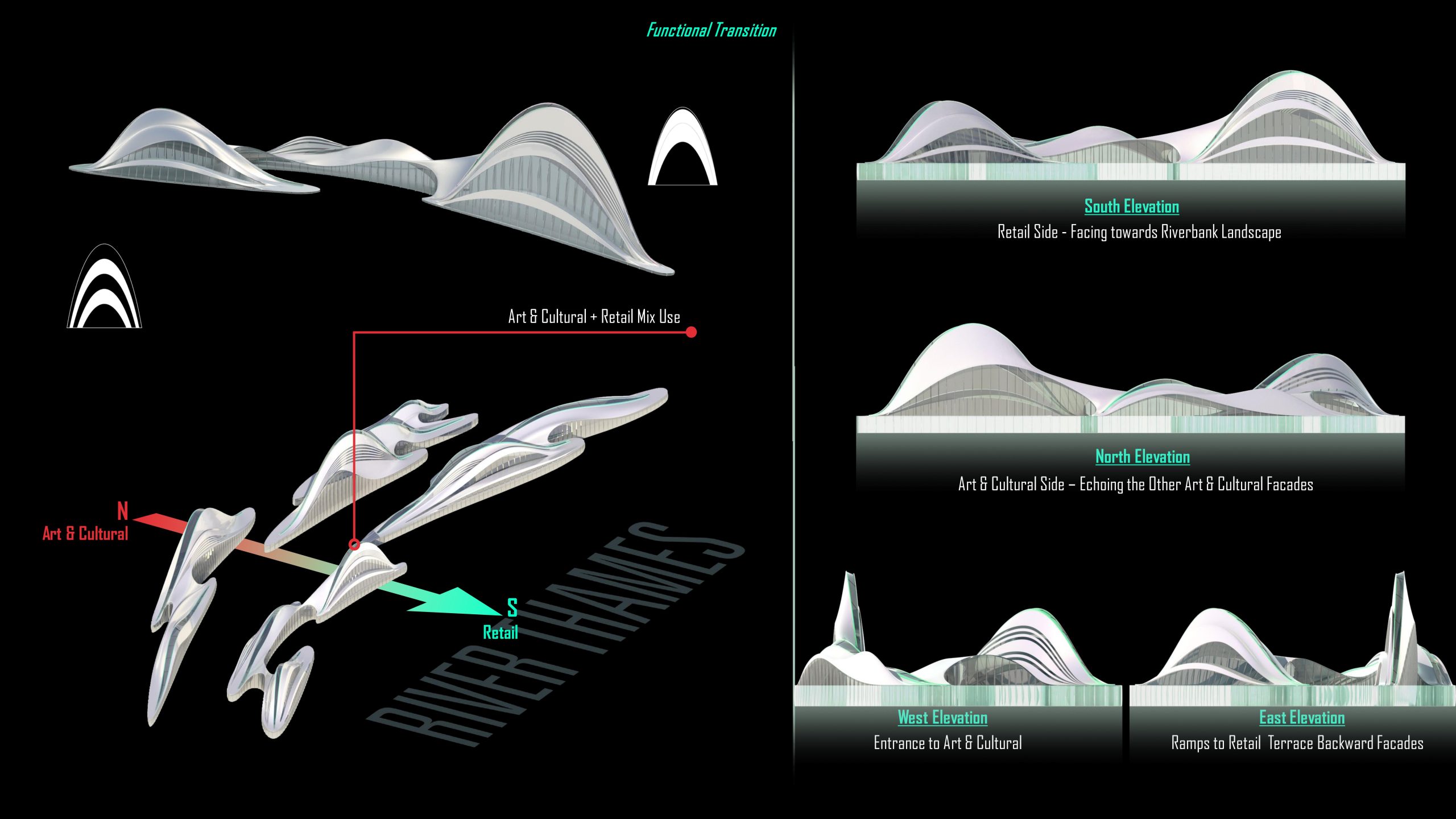
Functional-wise, we want to achieve this gradient: from art and culture gradually shift to retail from north to south, in the meantime reflected in the façade design.
The ribbon-like horizontal element separates from the folding skin, transforming ramps into the terrace backward retail facades. We hope this combination of forms can achieve a smooth transition between functions.
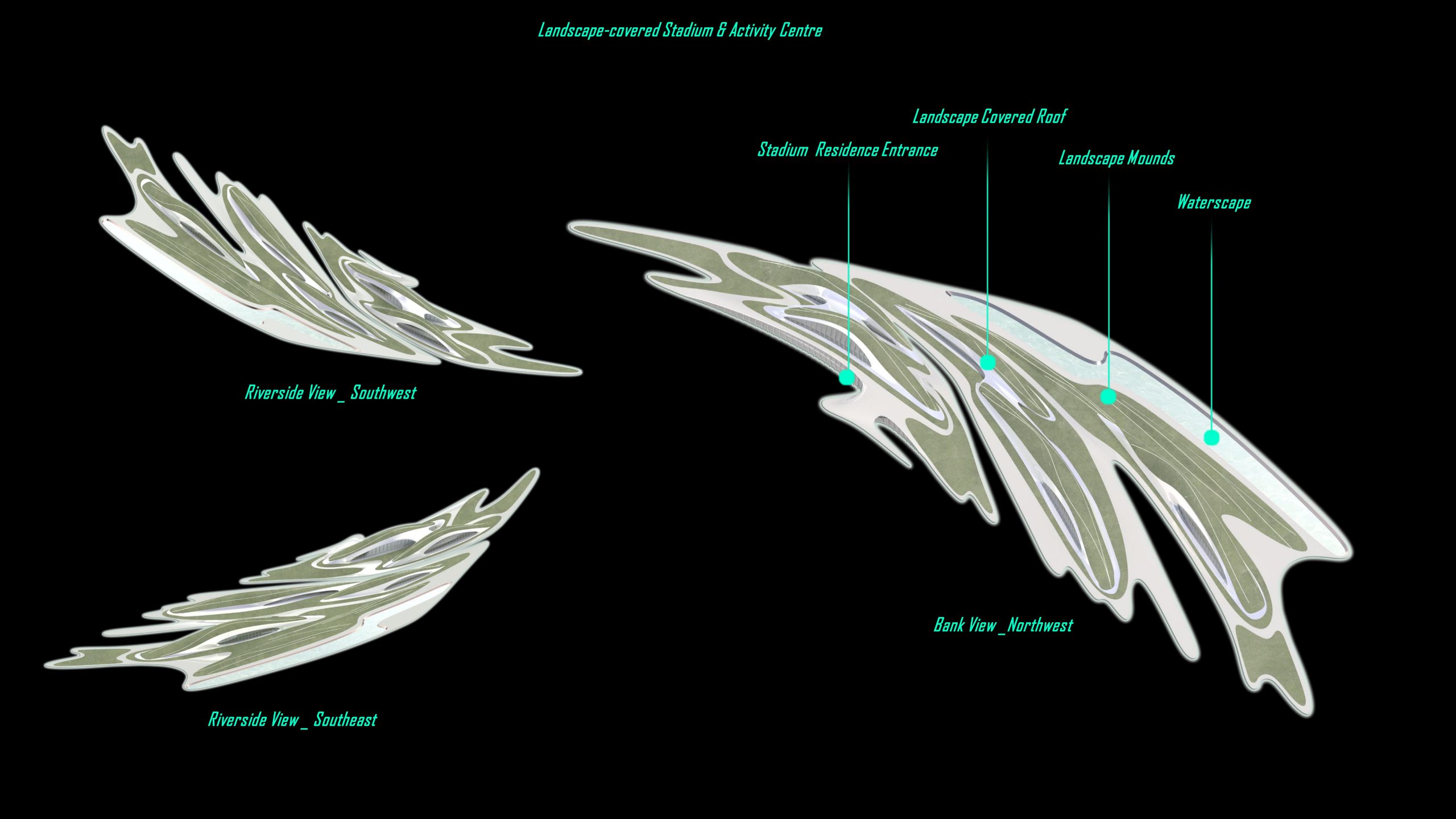
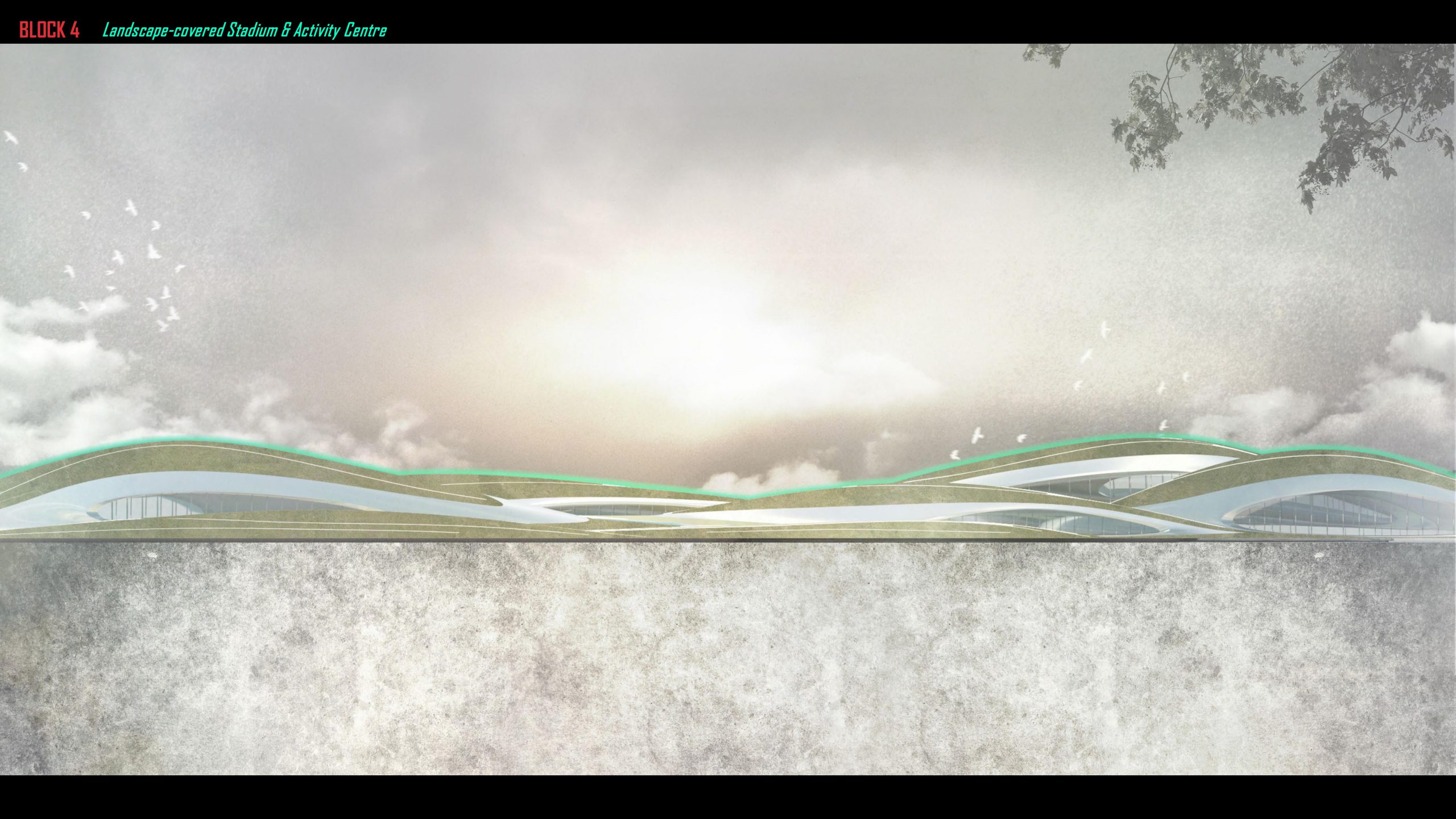
Move on to block 4. It is supposed to connect with art and cultural and residential apartment blocks, which are surrounded by a ring-shaped piece of landscape area.
Therefore we wish to bring landscape covered the building, gently blend with the landscape at the front.
With a similar bridging form of the art and culture but a much more natural gesture, embodying stadiums and other sports fields within to serve the surrounding residents.
BLOCK 1
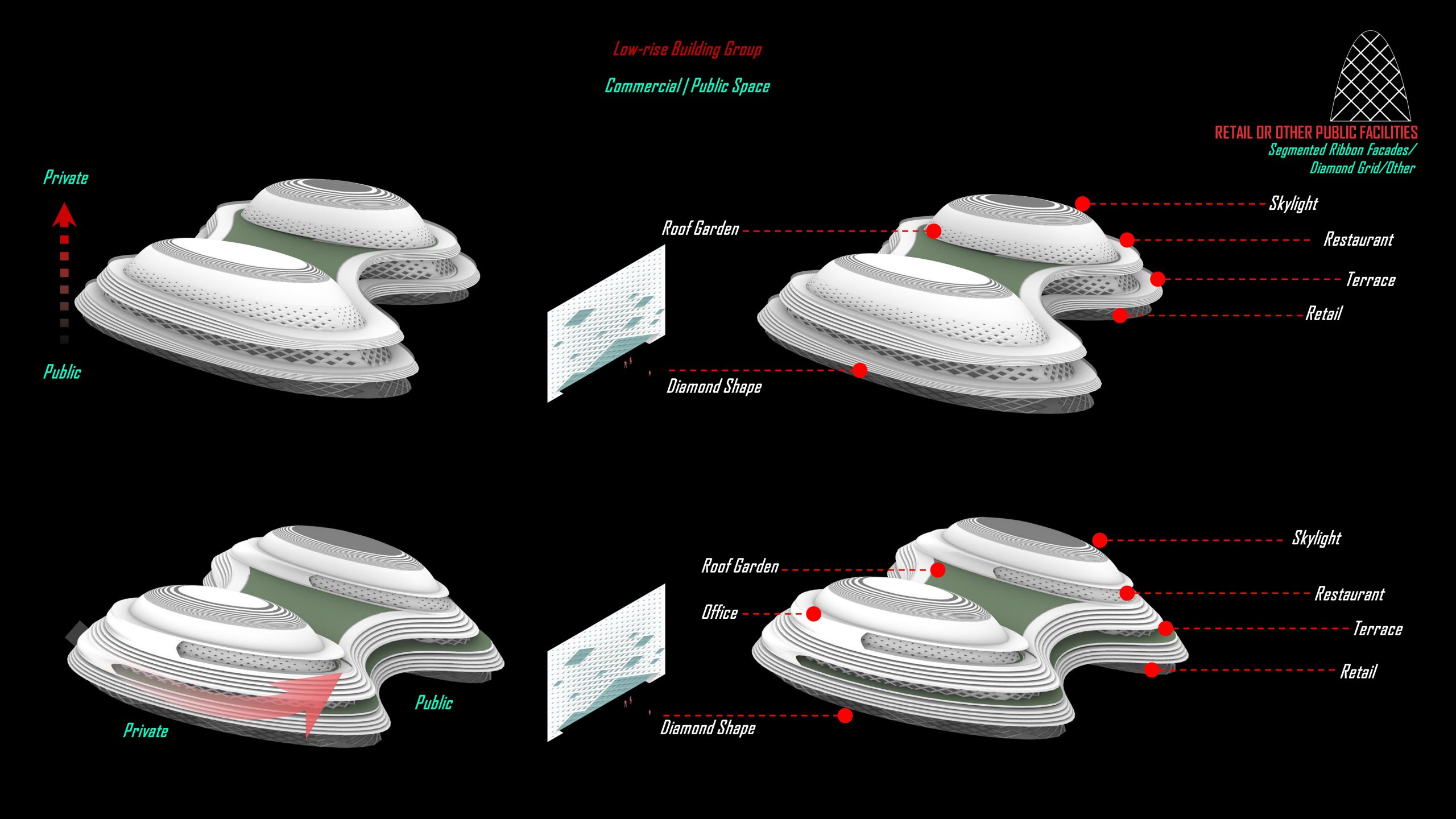
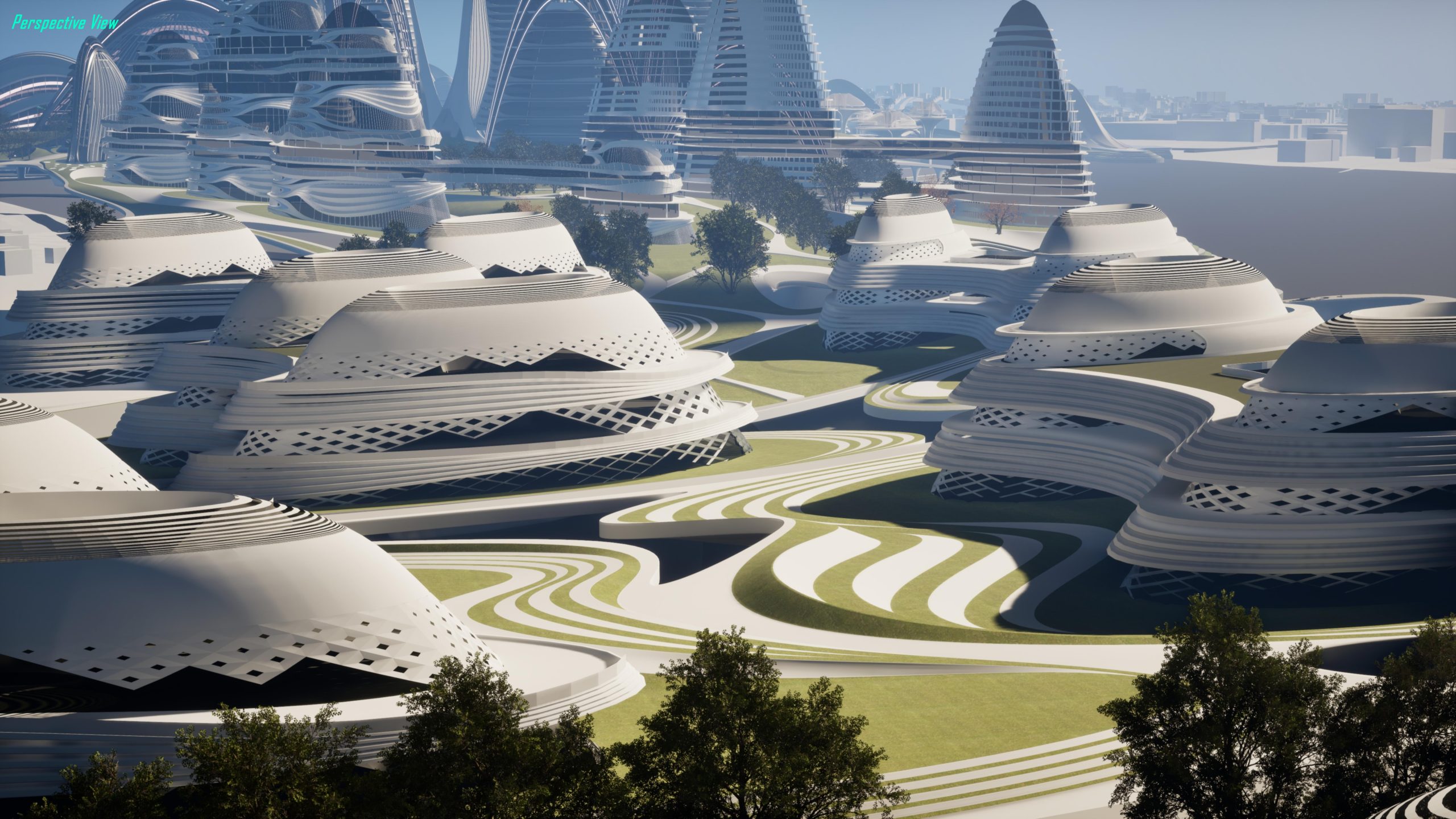
BLOCK 1: LOW-RISE BUILDING GROUP
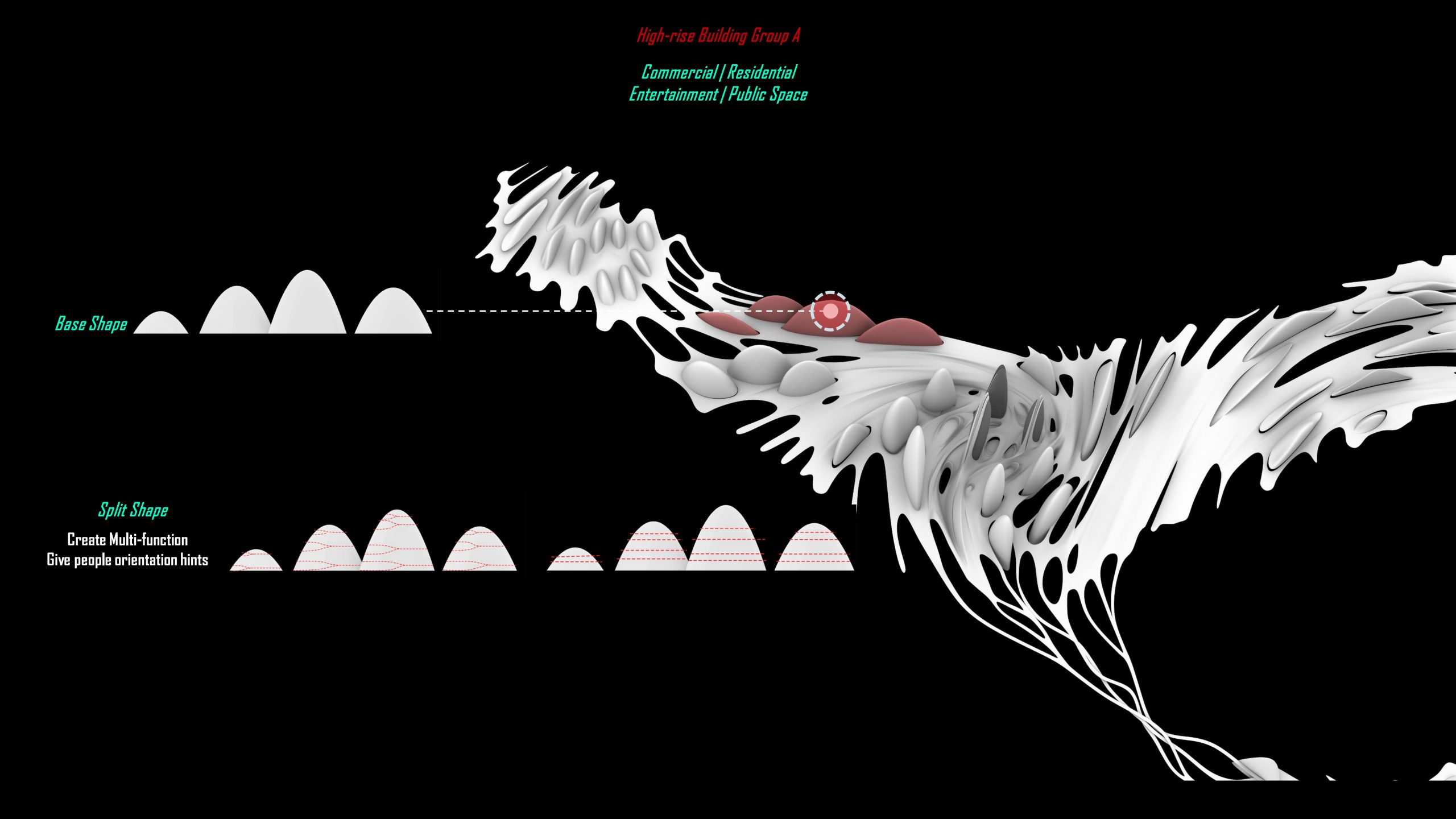
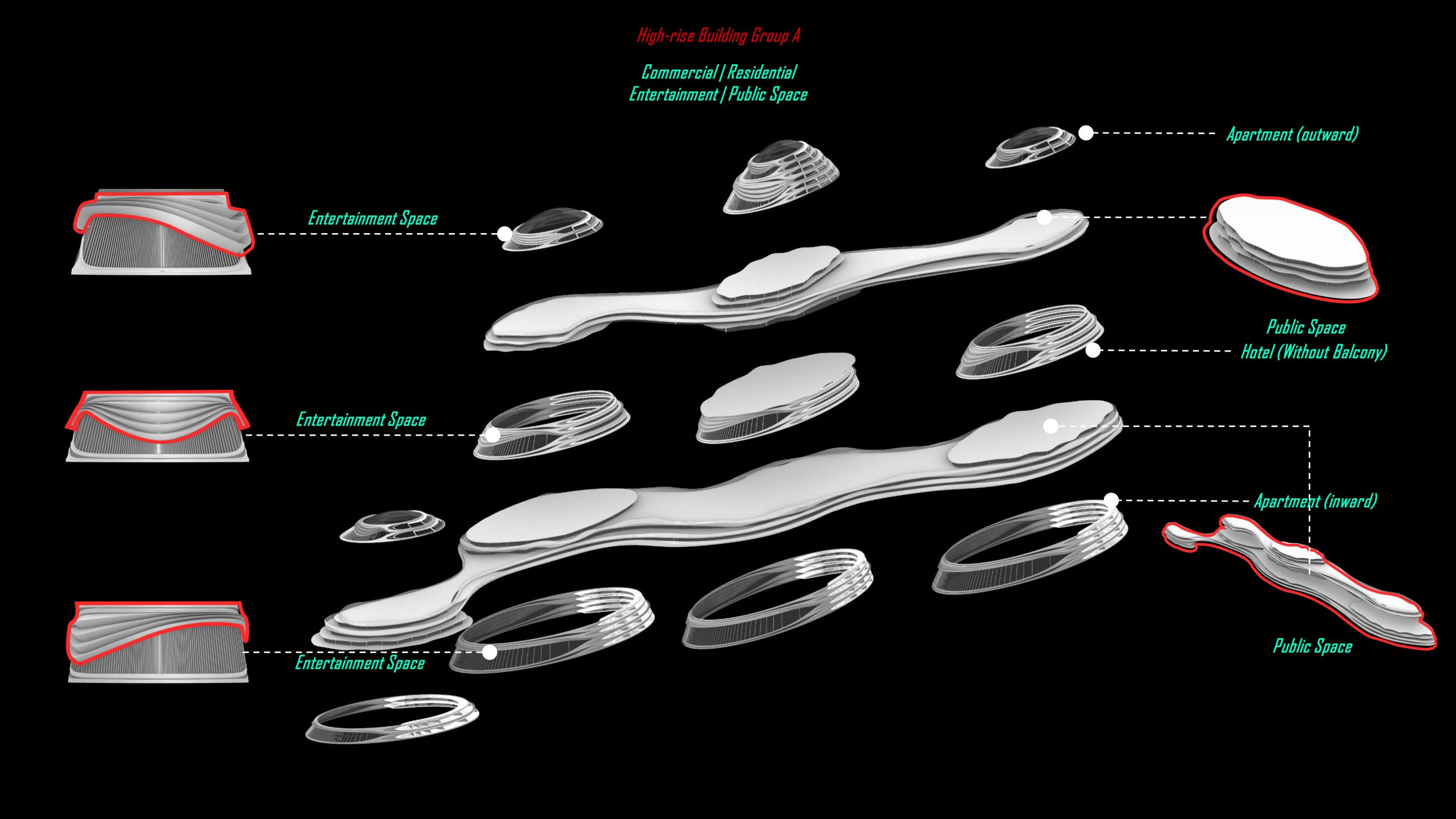
BLOCK 1: HIGH-RISE BUILDING GROUP A
BLOCK1: HIGH-RISE BUILDING GROUP B
BLOCK 5
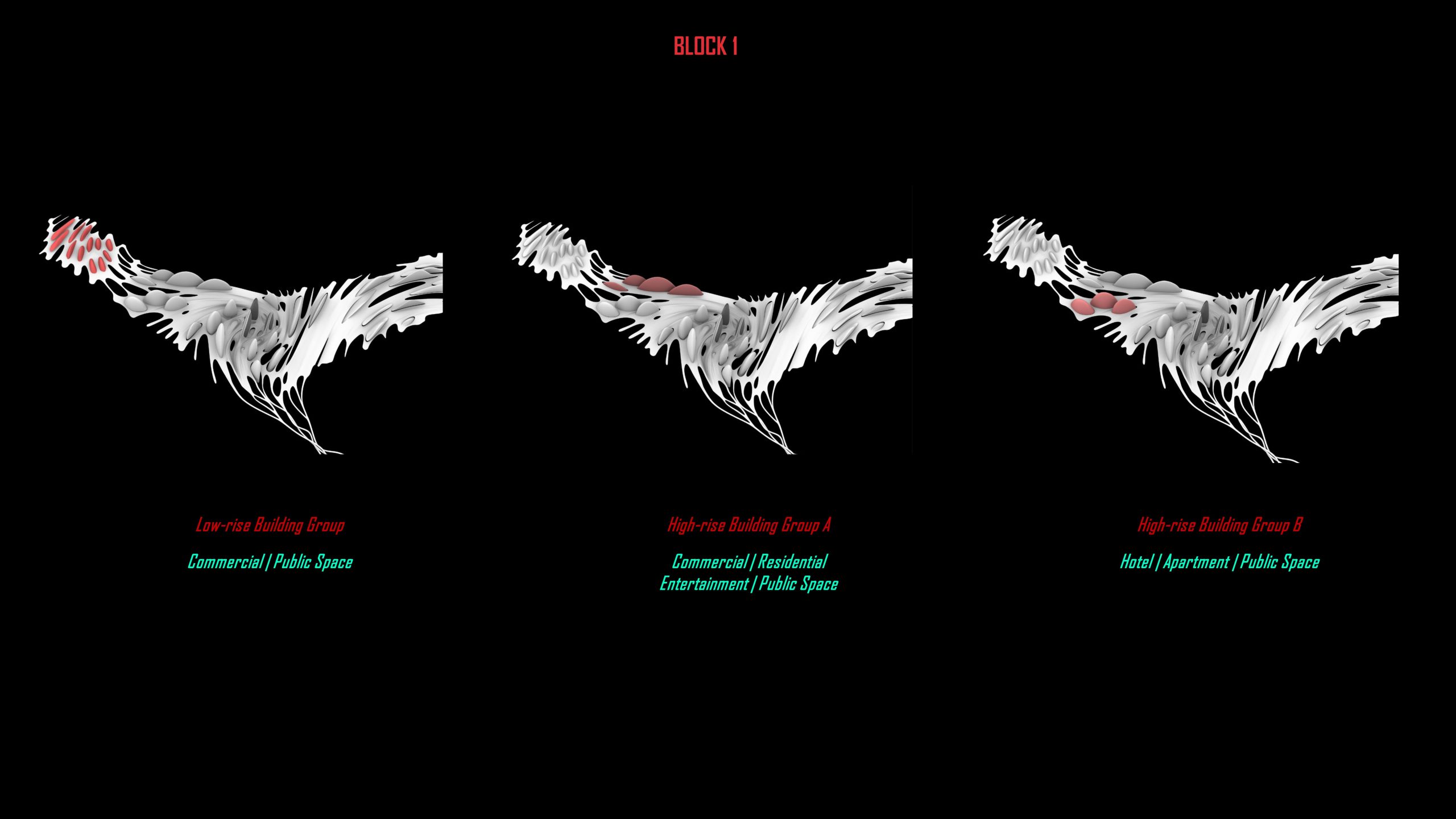
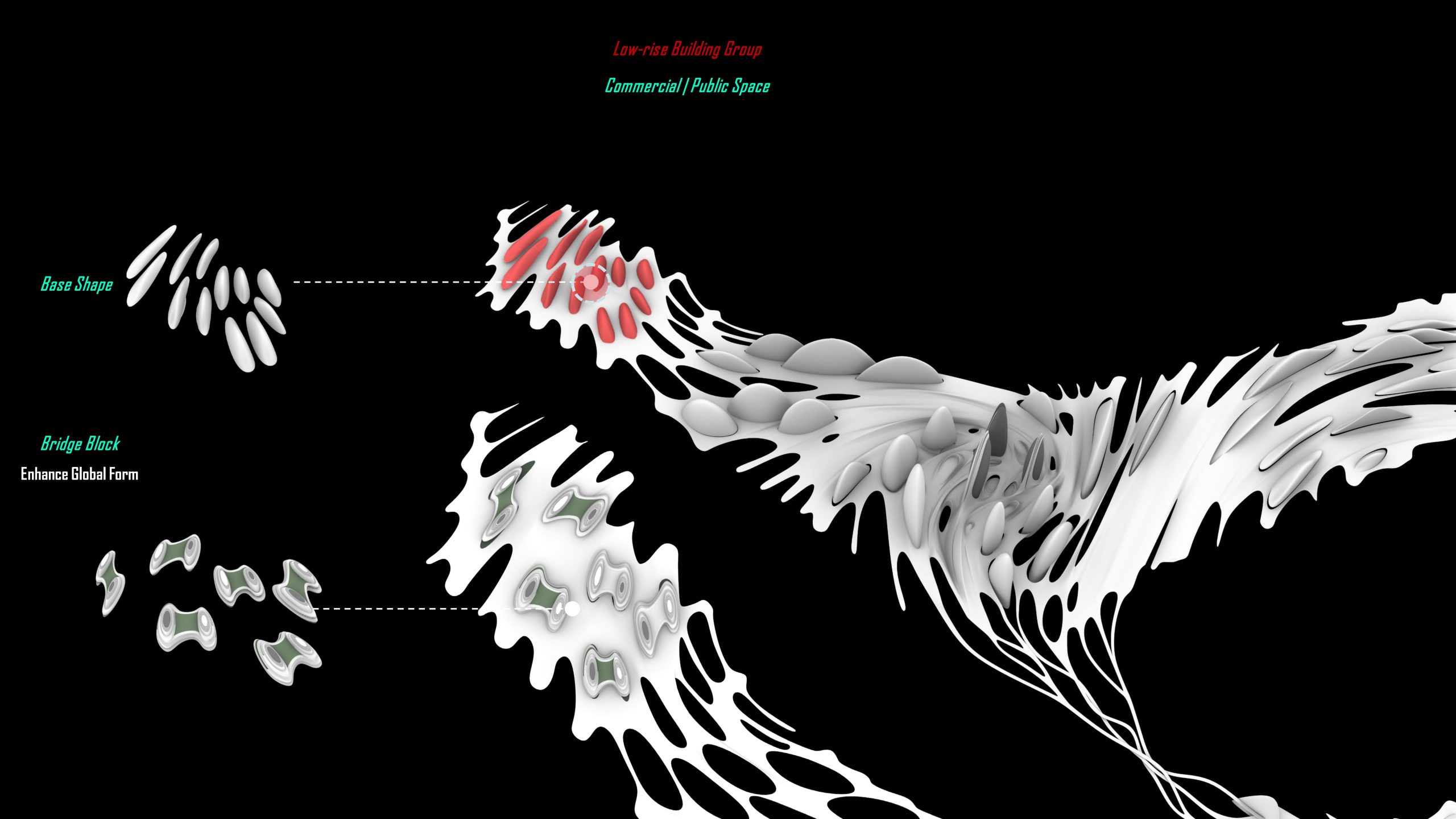
For block 1 we use the bridge language to emphasise the global form based on function, height and distance.
For the low-rise buildings of block 1, the main function is commercial. We start from the base shape that we generated before and try to bridge them.
We want it to make the transition from public space to private space, For example, from retail space to office space, we use the diamond shape pattern and change the size of the window to make the gradient.
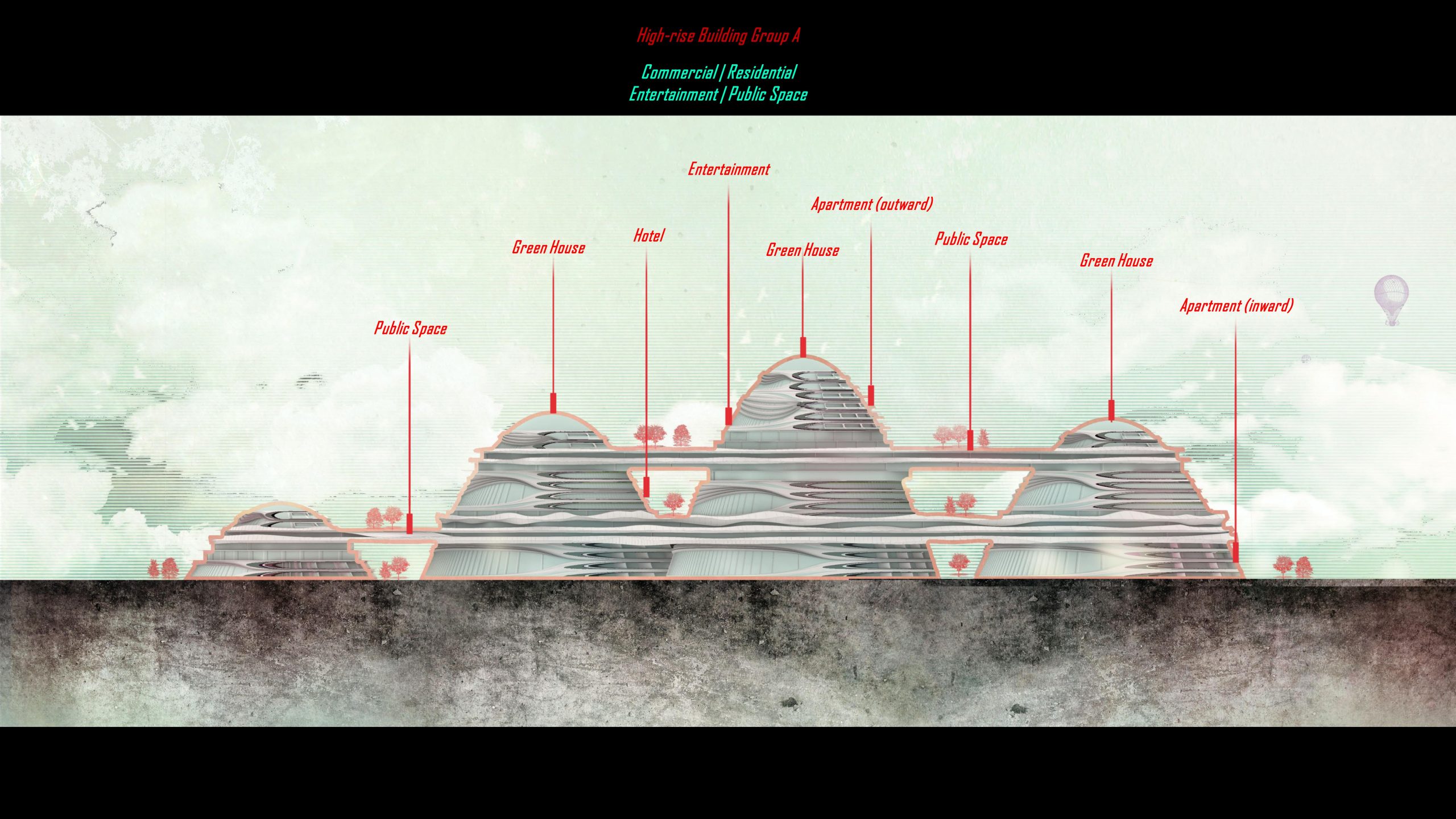
And for the high-rise building of block 1, we use the same bridge language and use horizontal curves to split the shape to distinguish different functions.
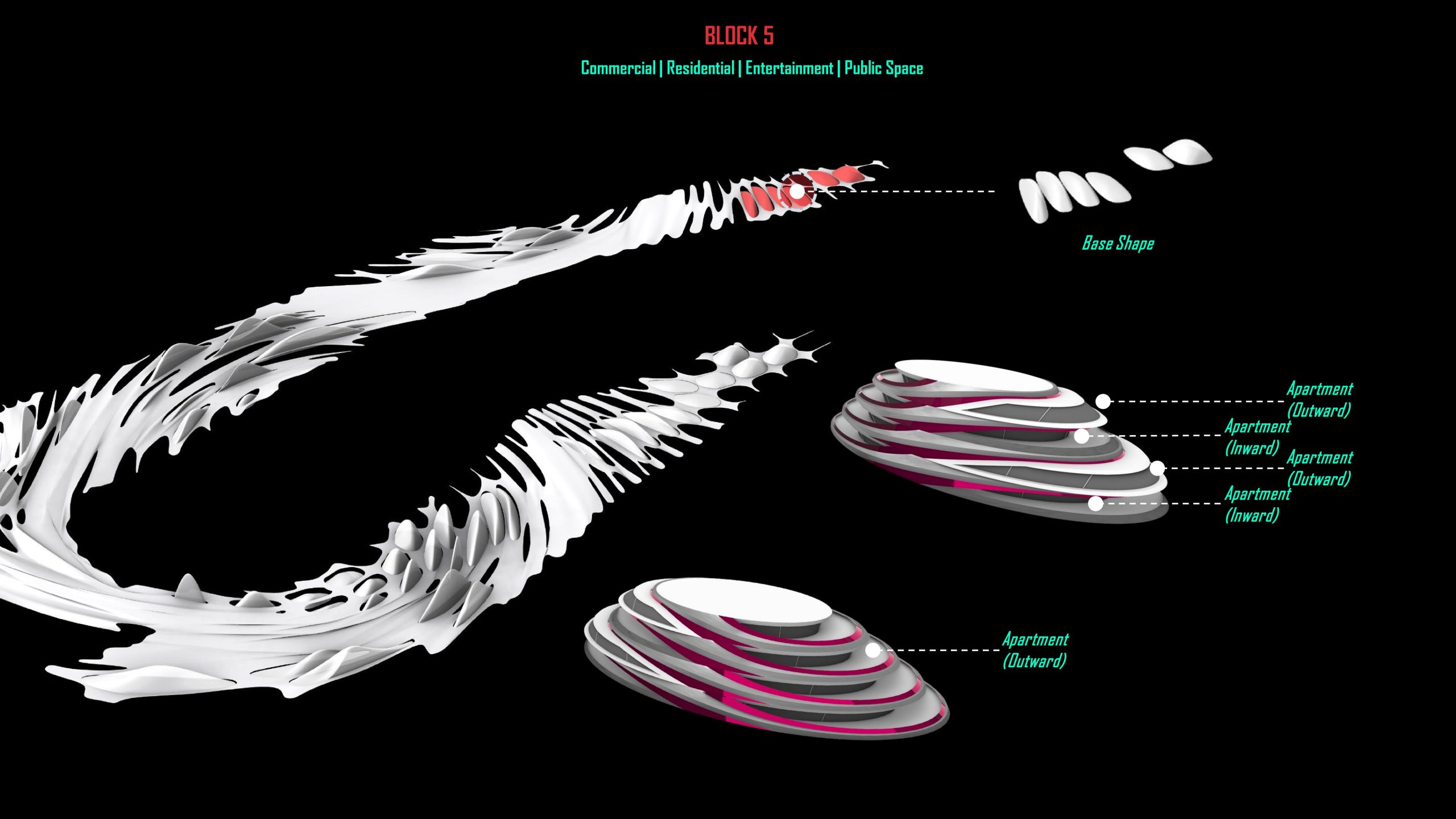
For the entertainment area, we create the muti-height of space and change the shape of the slab contour, and for the residential area, we use the language of balcony inward and outward for variations.
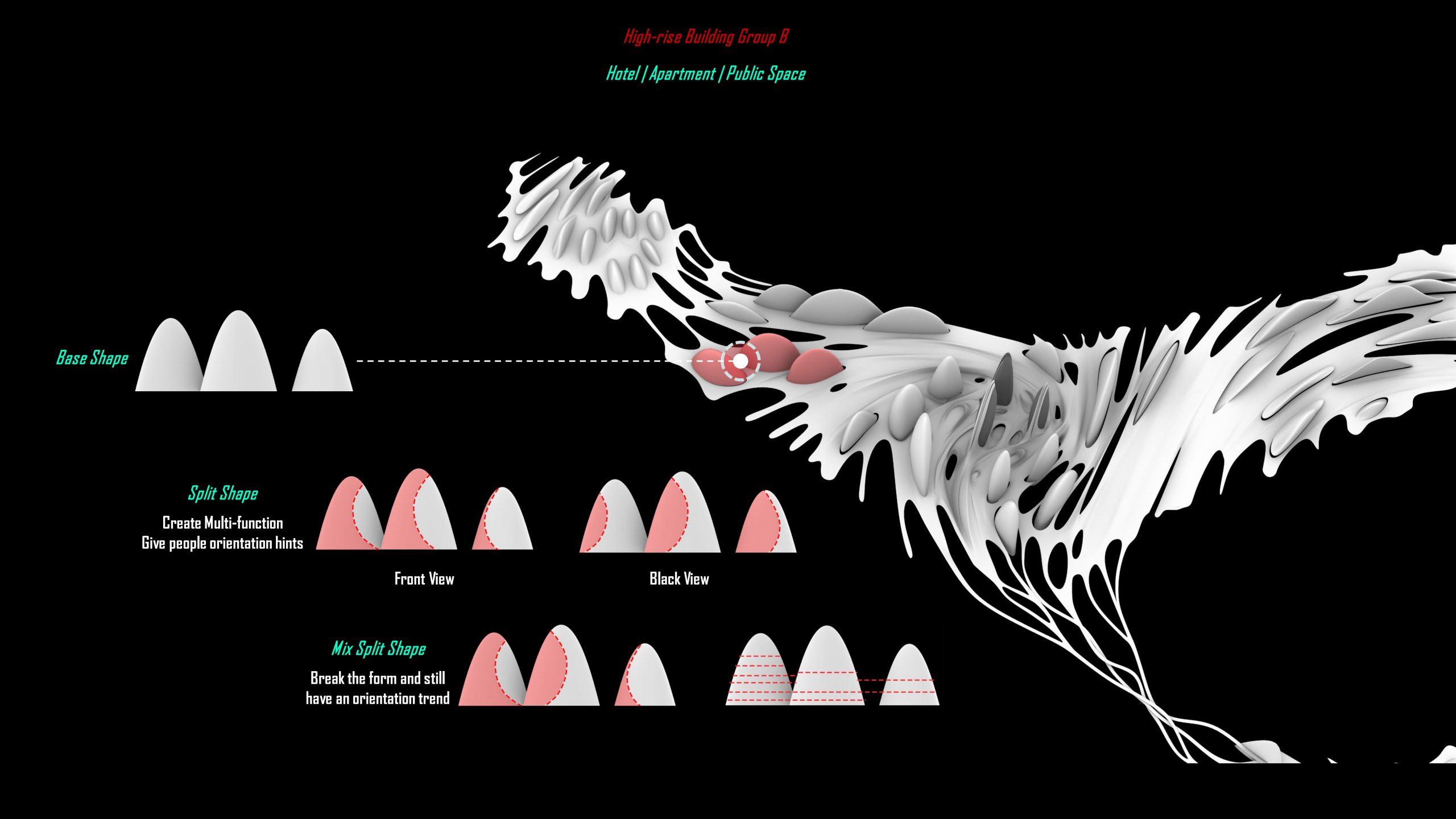
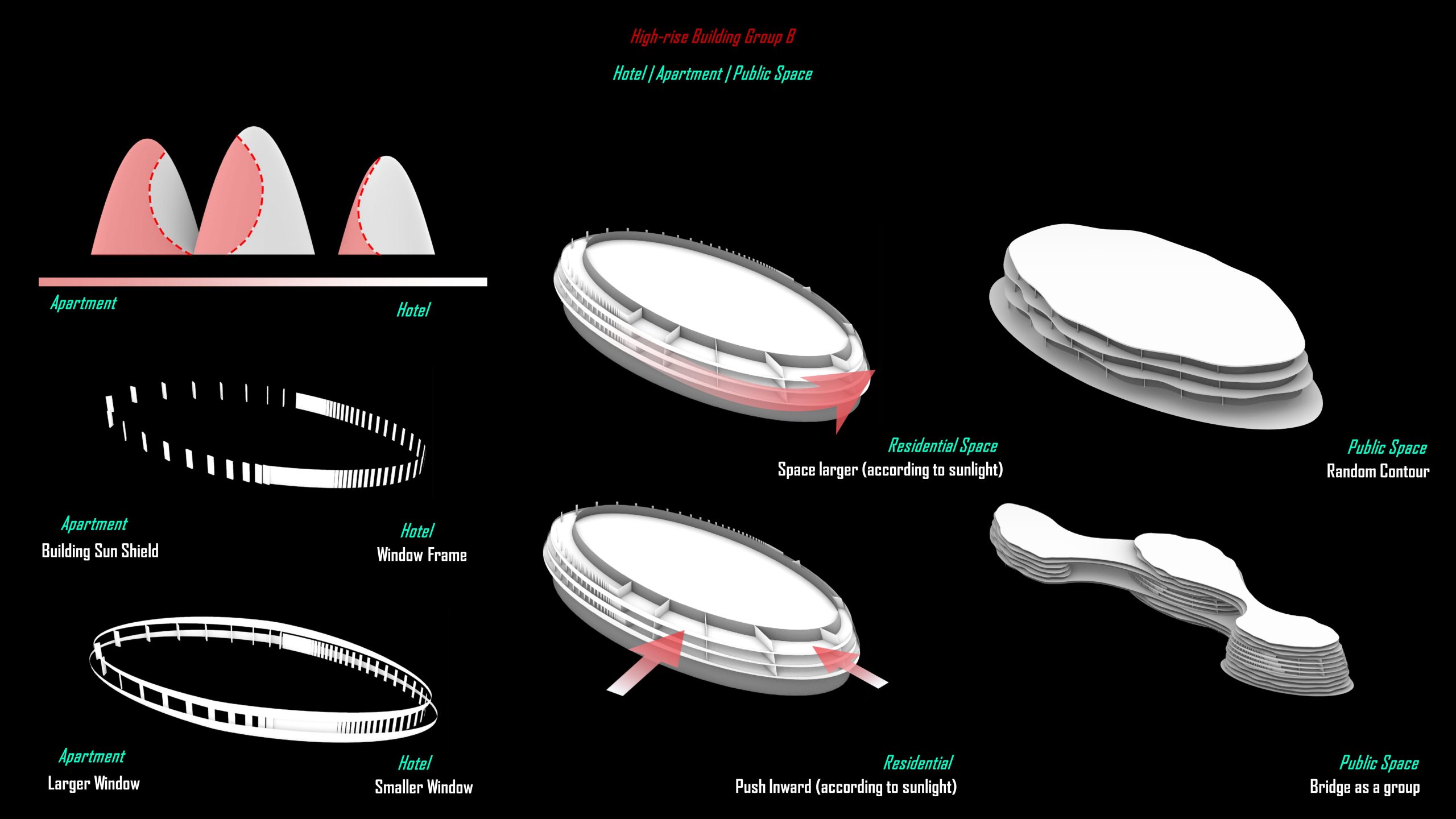
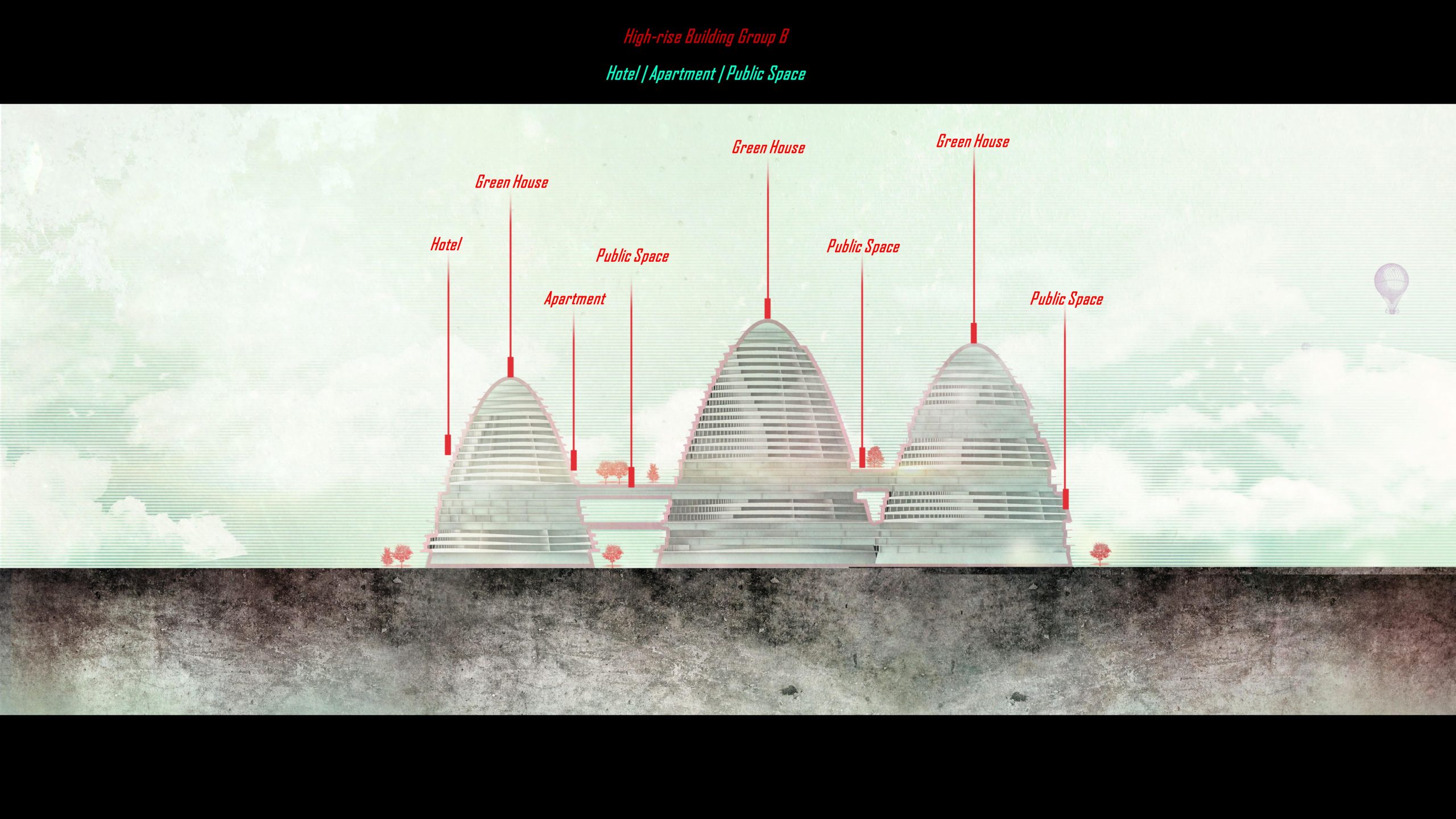
For the last three towers, we use vertical curves to split hotel and apartment space.
From the left side to the right side, it gradually changes from building sun shields to window wireframes and larger windows to smaller windows. It will let the building facade vary from void to solid, and the apartment unit sizes change according to southwest sunlight.
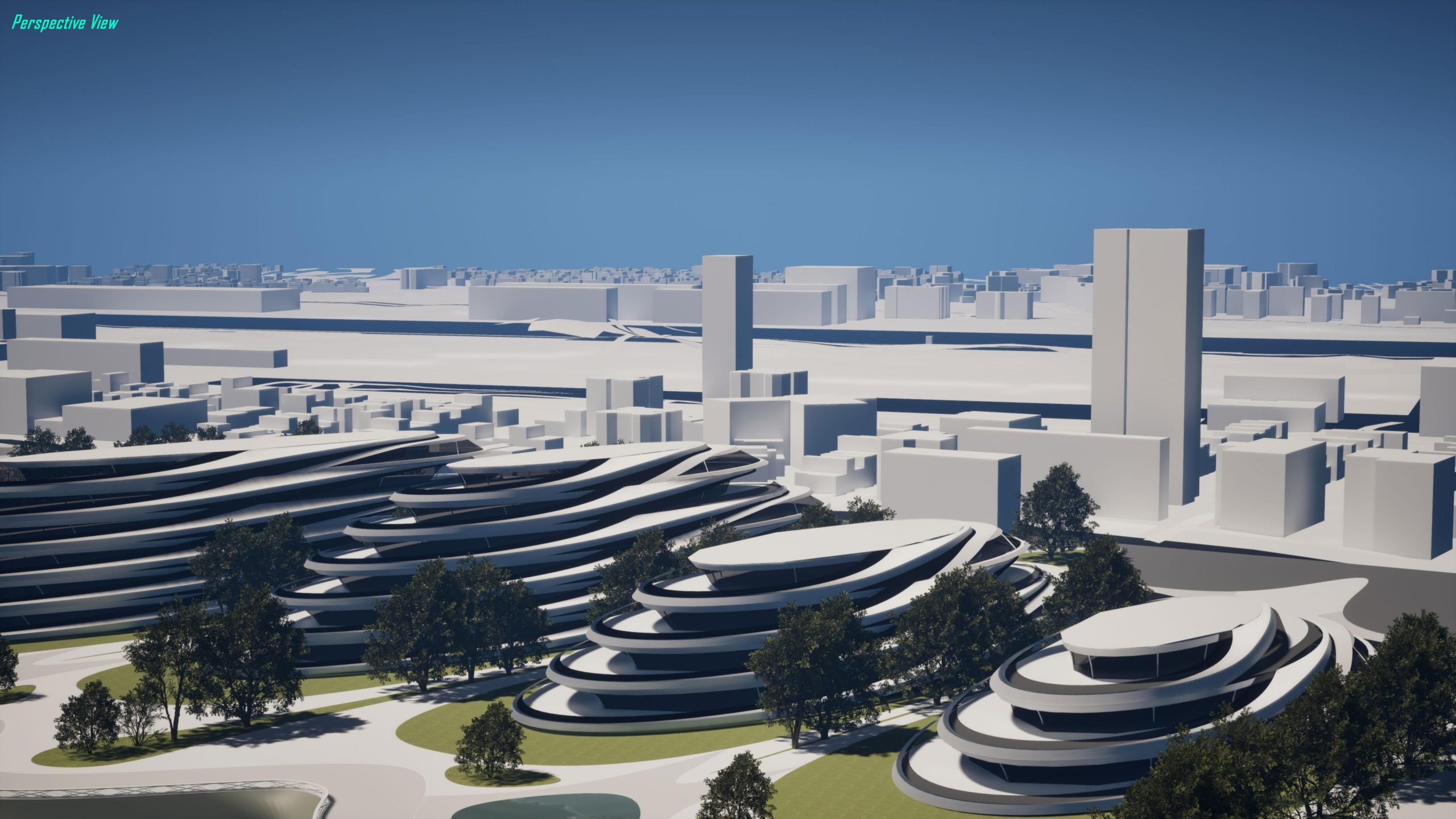
And for block5 the main function is apartment. It still echos the balcony inward and outward language.
BLOCK 6
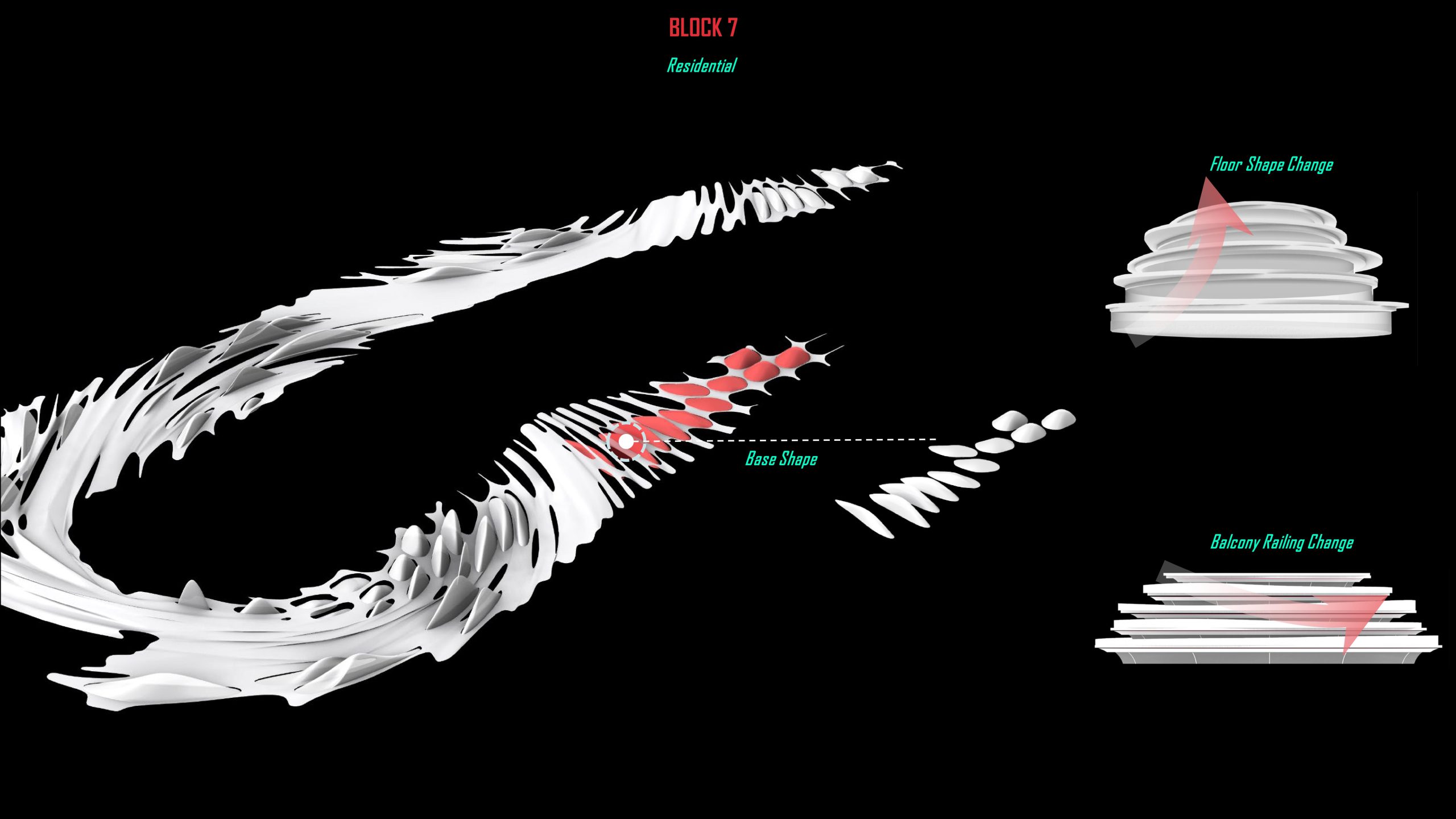
BLOCK 7
ANIMATION & STILL
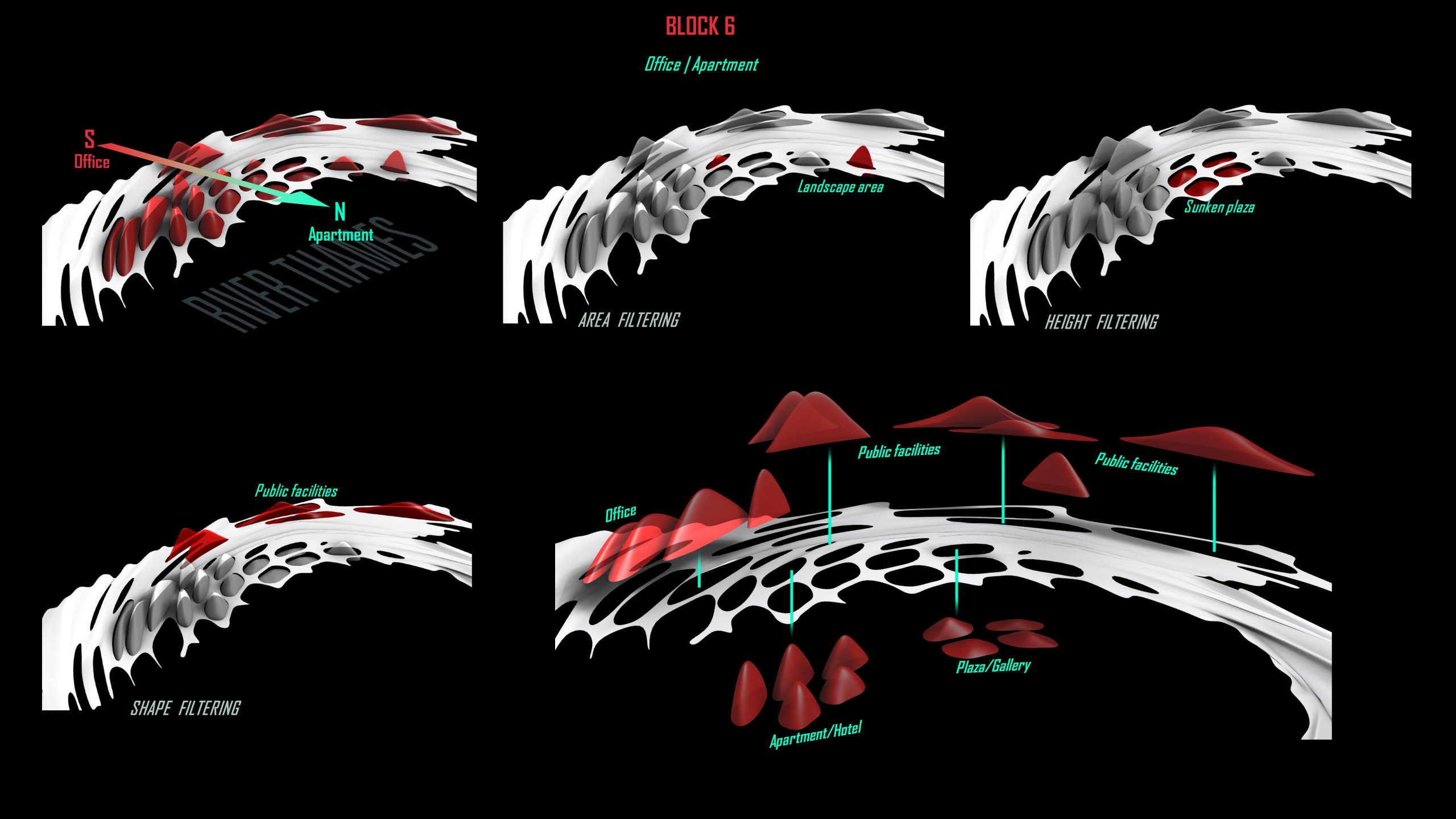
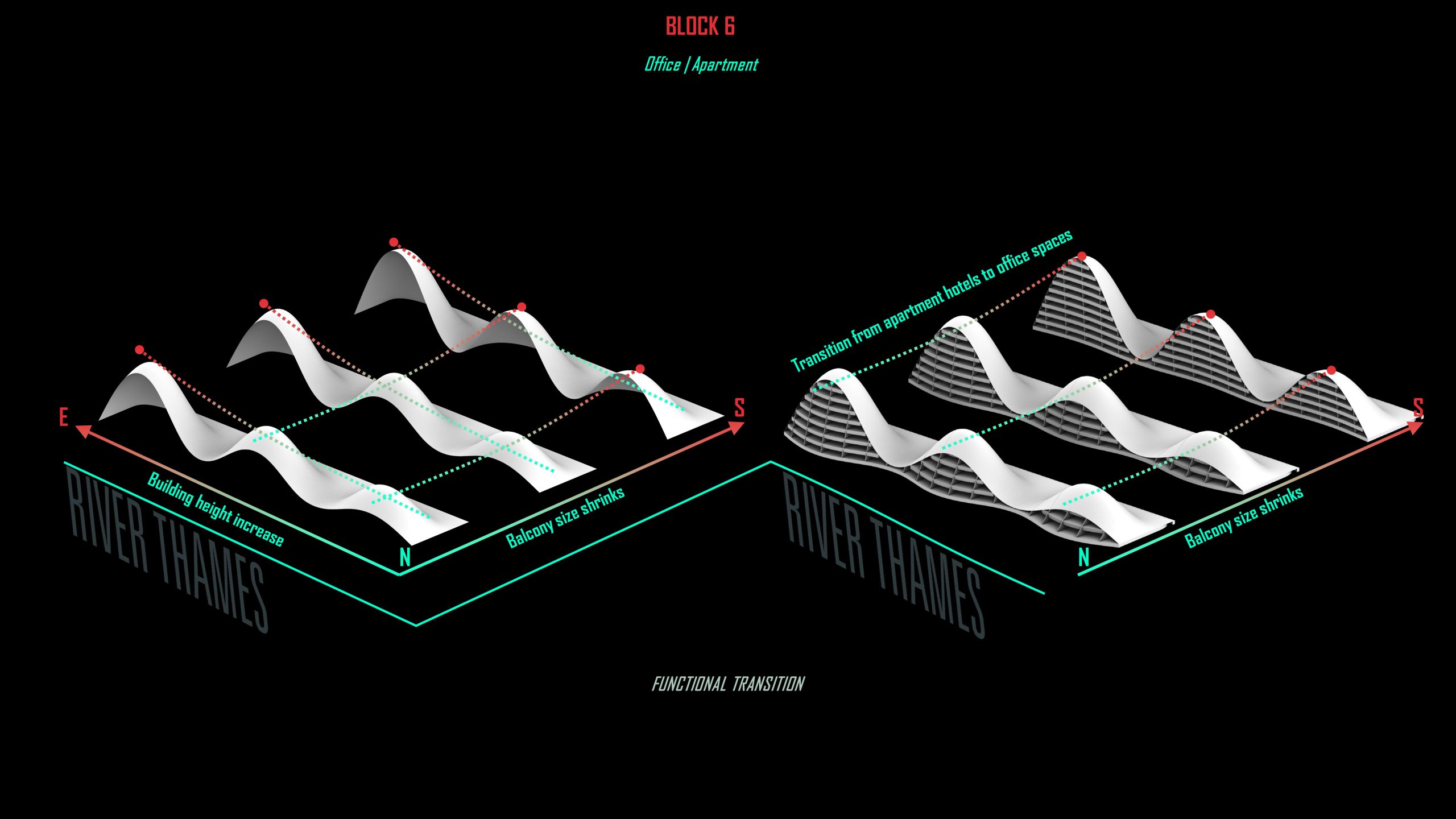
We classify Block 6 in four methods, office and apartment are distinguished by their distance to the river bank. Then we remove volumes that are too small and turn other low volumes into a landscape surface. Finally defining function by its shape, those that are too slender become public facilities.
As for the facade of the building, the skin covering the volume is gradually raised by the distance from the river bank, and the building height is gradually raised from west to east. Finally, the transformation of the apartment to office is completed by changing the extrusion size of the balcony from large to small to no balcony.